

Go sculptural! Are you an adventurous fuser ready to push boundaries and apply advanced techniques? If you answered yes, this project is for you.
The beauty of pattern bars is that they can be made in a wide variety of sizes, styles, shapes, and designs. The idea is to create a decorative element that can be cut into pieces and reassembled to make a unique and ornate focal point within your art.
Another nice thing about pattern bars is you can work small and still make a huge impact. So, don’t hesitate to try making your own decorative elements even if you’re new to fusing or have a small kiln. All you need is a little imagination and heat resistant material to contain your glass during fusing.
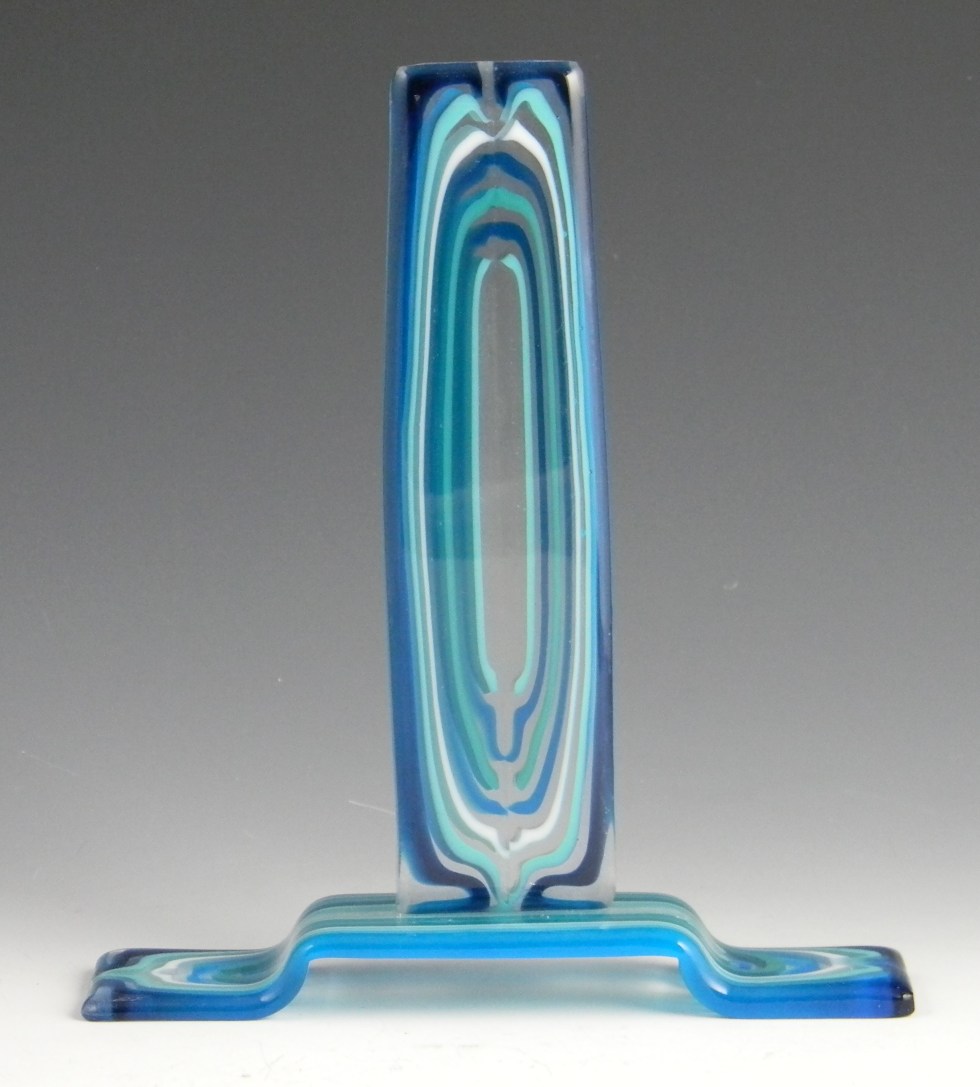
When I came up with the idea to fuse an inverted stack of glass, I wasn’t exactly sure what the resulting slab would look like. I didn’t let the unknown stop me from trying. I knew the hot glass would fill the open space in the container I created, but I wasn’t sure if the design would retain its linear appearance or if it the colors would blend together. As luck would have it, I got a little bit of both.

To make Reflection I stacked 16 pieces of glass. I started by cutting 3 inch wide strips from select opal glass colors and transparent glass colors. I also cut 3 inch wide strips of clear glass. The 3 inch wide strips were then cut to different lengths. No two pieces were the same length. I alternated color glass and clear glass. The glass was then stacked on the kiln shelf with the shortest piece down on the kiln first. Each consecutive layer was longer than the previous layer. It was like building an upside down pyramid.

Tip: When selecting my glass, I like to use a combination of opal glass, clear glass and transparent color glass. Each type of glass brings its own special facet to the pattern. Opal colors show off the intricacy of the pattern really well. Clear glass boosts the visual depth of the design, while transparent colors give the finished artwork a regal jewel tone quality.

When I fused the stacked glass, I contained it with ½ inch thick strips of fiber board. I use fiber board kiln shelves in my kilns. When they get damaged, I cut them down and use them as dams to contain thick glass. My firing guide is below.

Why do you have to dam the glass you ask?
When stacked glass is fired to the full fuse temperature of 1465 degrees it will spread out to a ¼ inch thickness. To construct thicker projects, we contain the glass with props, in this case fiber board. The fiber board is then held in place with kiln posts.
Tip: When I mention materials that I use in my kilns, like fiber board, I’m always referring to materials that I purchase from my art glass supplier specifically for kiln use. Don’t substitute other building materials from your local hardware store to save money. It will cost you in inconsistent results and possible kiln damage.

After the glass is fired the pattern bar was cut into long ¼ inch thick slabs with a wet saw. I use an inexpensive tile saw fitted with a wet blade for my heavy duty strait cutting. It’s fast, easy to use and gives me consistent results. The cut strips are then reassembled so the pattern on the left side is a mirror image of the pattern on the right side of the art. The glass is then fired a second time to a full fuse temperature. This bonds the pieces together and makes all of the surfaces shinny. I made two matching components. One will was used as the vertical portion of the sculpture.

I slumped the second component over a small block of ½ inch thick fiber board using the firing guide below. This element was then used as a decorative base to display the vertical portion. I glued the two pieces together with E6000 adhesive. I prop the project up and let the glue dry overnight.

Tip: Go the extra mile and build your own custom display bases for your special pieces of fused glass. It adds a personal touch that elevates the overall quality and sophistication of your artwork.

Pattern bars are a great way to add energy to your fused glass artwork. They’re easy to make and the number of design variations and color combinations is staggering. Plus, you can work small and still have dynamic results. Next time your kiln is sitting idle try an experimental pattern bar or two. Just watch out. The low pressure assembly combined with the thrill of unpredictable results is an addictive potion. I’m sure your new work will be both mysterious and magical.
Wherever you are in your artistic journey you’re doing great! We’re all learning new things every day. Keep going. Enjoy the journey.
Thank you for all the positive feedback about my blog and videos. It’s your kind and encouraging support that inspires me to keep sharing.
Happy Fusing!
Lisa

Reflection as seen in my, Advanced Glass Fusing video. This is one of 8 fun projects in my full length video. Download it now at www.LisaJVogt.com
Watch the, Reflection YouTube video here: https://youtu.be/NtYFb4PJnjQ
Fusing Guide
Segment 1: Ramp 300 F/hr to 1300 and hold 30 min.
Segment 2: Ramp 500 F/hr to 1465 and hold 10 min.
Segment 3: Ramp 9999(AFAP*) to 960 and hold 40 min.
Segment 4: Cool to room temperature.
*As fast as possible
Slumping Guide
Segment 1: Ramp 300 F/hr to 1265 and hold 10 min.
Segment 2: Ramp 9999(AFAP*) to 960 and hold 40 min.
Segment 3: Cool to room temperature.
*As fast as possible
NOTE: Kilns fire differently. Test fire these guides in your kiln and then make adjustments as needed.
Happy Fusing!
Lisa & Niki
Follow my blog for more tips and tricks!
Website www.LisaJVogt.com
YouTube http://www.youtube.com/watch?v=dhOifd7wukk
Facebook www.Facebook.com/LisaJVogt
Twitter https://twitter.com/lisajvogt
Instagram @lvogt_originalsinglass


Watch it NOW! Start fusing today!

Downloadable instructional videos for every skill level.

Check out my eBooks for elegant patterns and detailed fusing instructions.