

Introducing Ocean Paradise an Art Glass Mosaic Doghouse
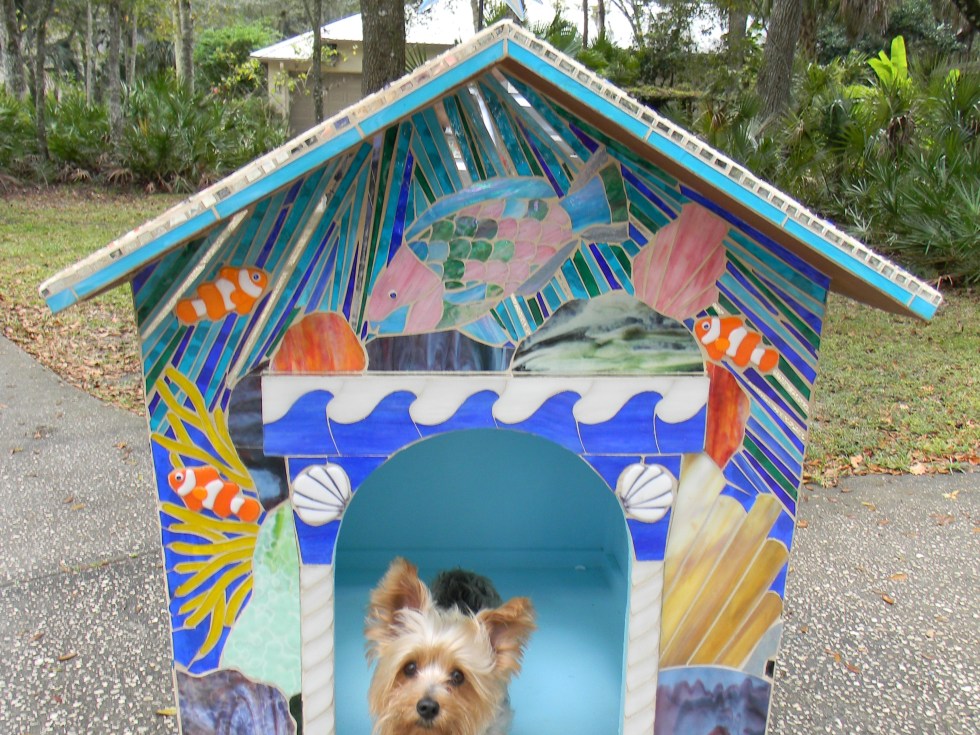
Finally, the day I’ve been looking forward to for months is here! I’m unveiling the large scale mosaic project you’ve seen close up, teaser pictures of for months. Ocean Paradise is a full size, functional doghouse covered with an art glass mosaic design. It was made for the Outdoor Arts Foundation, BowWow Haus Tampa II. The doghouse is on public display and will be sold to benefit the Outdoor Arts Foundation.
As the saying goes, pictures are worth a thousand words. Here are some fun facts and images of the construction and fabrication of the doghouse. Enjoy!
Outdoor Arts Foundation
Presents
BowWow Haus Tampa II
Ocean Paradise Dog House
Designed and built by Lisa and Joe Vogt
Medium, Wood Frame and Art Glass Mosaic
Dimensions 3’ x 4’ x 4’
Ocean Paradise Fun Facts
It took hundreds of hours to decorate the dog house with the stained glass mosaic. The project took us 8 months to complete. The ocean was my inspiration for the mosaic designs. The front gateway design was inspired by the lost city of Atlantis.
Joe built the sturdy plywood substructure with his amazing wood working skills. The house is made with 1” x 2”, 1” x 8” boards and ½” thick plywood, so it would be strong and light weight. The feet were made with 2” x 8” pressure treated boards to improve longevity if it’s ever displayed outside.
There are more than 75 square feet of stained glass on the dog house. Each piece of glass was hand-cut one at a time. There are thousands of pieces of art glass in the mosaic design. Some of the beautiful glass used to make the mosaic is no longer available.
Family and friends helped me cut and glue glass on the wood frame. Everyone who worked on the dog house said they had fun. Some of my helpers had never cut glass before. With a little coaching, they did a great job!
I’ve always loved hidden picture drawings. I wanted to give the viewer different treasures to discover on every side of the dog house. I designed different subjects on each side to keep the fabrication fun and engaging. An iridized green moray eel swims on the back side. There’s a small sting ray on the side with the mermaid.
I drew some of the designs on the computer and then transferred them to the wood frame. The octopus celebrates a stunning sunset with a flashy dichroic martini glass.
Thanks to watermelon martinis, the mermaid’s scales were glued on upside down! The next day, I scraped each scale off and re-glued them the correct way, and then celebrated with another martini.
It took days to cut and layout the glass strips to make the subtle color transitions on the roof of the dog house. One side of the roof is a beautiful sunset. The other side of the roof is twilight, complete with an exotic ripple textured glass moon.
The clown fish, sea turtle, and dog weather vane are fused glass. The clown fish turned out so cute, I almost didn’t use them. I wanted to keep them for myself. But they added so much to the design I had to include them.
The dog weather vane is made out of CBS dichroic glass. Did you notice the cute heart design on his chest? The dynamic weather vane also turns.
The glass was glued onto the wood substructure one piece at a time with clear caulk. We used four tubes of caulk. The background glass pieces were custom cut and glued to fit around the fish, mermaid, and octopus.
A silver thread of mirror winds around the dog house, visually connecting all of the sides. The hibiscus flowers are made with pink iridized glass. There’s a cute window box with sea weed growing out of it on the back side.
It took five pounds of grout to seal the stained glass mosaic. It took 6 hours to grout and clean the dog house. The finished dog house weighs about 100 pounds.
I signed the artwork on a piece of glass near the front door with a diamond bit and Dremel. I don’t have a favorite image in the design. I love everything! We spent many fun, family nights and weekends cutting and gluing glass.
Pictures don’t do Ocean Paradise justice. The live, in person 3-D experience is amazing, almost overwhelming. I took thousands of process pictures. It took hours to sort and arrange the images. It was easier to cut pictures of my kids than pictures of our pets.
After so much time and effort, it’s not hard to see it go. I’m happy the rest of the world will now be able to enjoy our dog house as much as we enjoyed making it.
Why did I do it? I love new creative projects, sharing the beauty of art glass and making people smile. I enjoy inspiring others to wonder and explore their potential for giving their own gifts generously. It’s not much, but I hope my art makes a positive impact and brings a little magic to everyone who sees it.
Ocean Paradise was made for the Outdoor Arts Foundation, BowWow Haus Tampa II.
Ocean Paradise is my second full size, functioning mosaic dog house. Tropical Retreat was my first BowWow Haus mosaic dog house. It was built in 2003.
Thank you to Jay Gould at the Outdoor Arts Foundation for inviting us to participate in the BowWow Haus Tampa II project. Thank you to our sponsors, Jay’s Aunt Rochelle and Uncle David.
Special thanks to my family and friends who generously helped me with the doghouse. Joe and Niki Vogt, Jessie and Jake Battin, Kelly and Emily Miller, Tony Varandas, Elise Hardesty, Caitlyn Ward, Barb Chenowith and Jonathon Amerman.
Thank you to our furry family who supervised the entire project beginning to end. Trixie, Titan, Tyke, Natsu and Lucy. Special thanks to Titan for being a very patient doghouse model. He earned extra cookies.
Ocean Paradise is currently on display at the Reeves, Volkswagen showroom in Tampa, Florida.
Sculptural Fused Glass, 4-Day, Hands-on Workshop, October 15-18, 2019
I’m offering a 4-day workshop with a focus on sculptural fused glass. You’re invited to join me and take your fused glass to a sculptural level. Register www.lisavogt.net
Wesley Chapel, Florida, 4-Day, Hands-on, Class size is limited.
Sculptural fused glass is the creation of three-dimensional forms that rise above a flat plane. Artists create 3-D works by using multiple methods and techniques with complete freedom of materials and process.
Sounds exciting, right? All you have to do is stand your art up and it’s miraculously sculptural. Sure, you can do that. The word sculptural sounds exotic. Add it to any piece of art and suddenly it has a mysterious aura surrounding it and a significantly higher perceived value. But like most really exceptional work that looks easy, there’s more to making impressionable art than just erecting a flat piece of fused glass.
The real difference between art and craft is the depth of immersion the creator puts into the creation of their art.
Hobbyists copy. They follow outlined directions and build pretty pieces according to a pre-tested recipe. Don’t get me wrong, there’s nothing wrong with doing that. Hobbyists want to know they’ll be successful and have beautiful results. Especially after all the time and money they’ve spent on a pass-time.
I’m a hobbyist when it comes to other popular hobbies like music, bird watching and video games. That’s how we learn. By following the pros and picking up their tricks, we learn how to make things we’re proud of and admire.
And if you become hooked, maybe you take your hobby a step further. You try new techniques and experiment by mixing techniques or combining ideas that inspire you. This is the threshold of advanced learning and the blossoming of self-discovery. You wonder, what can I do? What can I make? How far can I go? And the real question is, what am I capable of artistically.
Hobbyists often start a hobby to relax and enjoy quiet time. They are content to stay in the shallows where it’s safe and they are successful. And that’s admirable.
Artists, on the other hand, take their commitment more seriously. They’re drawn to a medium by an invisible magnet. From the start they’re compelled to learn as much as possible about that art form. They have every intention of progressing, to work on bigger, better, more advanced projects. They head for the deep end without looking back and, sink or swim, give it all they have.
What does this have to do with sculptural fused glass?
Sculptural fused glass is the product of such artists. They’re the ones who go above and beyond. They challenge convention and push boundaries.
You may think it takes extensive experience and an impressive glass studio to be one of those pioneers. You’d be wrong. Your most valuable assets are a positive attitude, insatiable curiosity and a fearless willingness to try. Just try. Trying is worthy of celebration and cheers.
How to get started.
I recommend making small 2 inch x 2 inch samples using different, new techniques that intrigue you. This gives you construction and firing experience with these new methods to see how they fire in your kiln. Then consider mixing methods that you’d usually do independently. Take these component pieces and cut them up. Then put them back together in a new way.
Slump plain clear fusible glass over molds in unique ways. Try combining different shapes to make sculptural groupings all your own. Again, start small. You can always take a successful project larger. Once you have a winning combo slump your component pieces the same way.
Take notes and pictures so you can repeat your successes and learn from mistakes.
Your biggest obstacle is likely you. Get out of your own way. Start small. Make tiny changes. Results are results. They don’t have to be monstrous to have enormous value.
If you’ve come this far in your craft, if you’re continually seeking inspiration, knowledge and community, I believe you have it in you to create your own unique sculptural fused glass.
Wesley Chapel, Florida, 4-Day, Hands-on, Class size is limited.
This class is for you! Any skill level can attend. Beginner, intermediate and advanced students alike will learn how to advance their glass fusing skills and expand their artistic style.
In this class I’ll show you all the pro tips and tricks I use to make stunning 3-dimnesional art. You’ll learn how to combine advanced techniques in new ways to create extraordinary sculptural pieces of art.
But it’s so much more than that! You’ll get personal instruction. I’ll show you pro tips and tricks to improve your glass cutting. We’ll mix different fusible materials.
On day 1 you’ll make a free flow. You’ll be firing your first project before lunch. Learn how to use Skutt’s Touchscreen Controller and the KilnLink app. Then you’ll design and cut glass for a combed piece.
On day 2 you’ll comb molten glass and weave glass. You’ll love the personalized class structure. You get to pick your own glass colors and get to choose the style and shape of the sculptures you make. I cater the class to each individual student’s skill level, plus their unique needs and artistic goals. I have 35 years’ experience teaching glass art. It’s what I love to do.
On day 3 you’ll design, build and fire your sculptures. You’ll also slump components for complex pieces. I’ll show you how to use slumping molds in new ways to create unique shapes.
On day 4 you’ll put your slumped components together and learn how to photograph your art. In this hands-on class you’ll learn how to load, program and fire kilns. You’ll fuse, slump and tack glass together. Plus, learn how to make graceful glass stands to display your pieces of art.
You’ll love the stunning three-dimensional results you get from combining all these concepts.
Materials are included, that’s a $150.00 value! Plus, a professional photo shot of your artwork is also included.
You’ll leave class with several completed glass sculptures, my custom firing guides and a deeper understanding of sculptural fused glass fabrication. You’ll have the knowledge, confidence and inspiration you’ve been craving to take your artwork to the next level.
Come to my glass studio and we’ll make beautiful sculptural art together. This is the turning-point workshop you’ve been waiting for.
Join me October 15-18, 2019 and we’ll get fired up!
In this detailed Webinar, I’ll reshape the way you slump and drape glass. See how thinking outside the box and using readymade molds in new ways offers numerous and exciting opportunities to produce unique forms.
You’ll learn how to make your own graceful, free-form shaped molds from readily available materials with no laborious measuring or messy mixes needed. Taking you one step further, I’ll show you how to use these different approaches, in combination, to transform ordinary projects into inspiring, sculptural pieces of art!
Watch it NOW! Start fusing today!
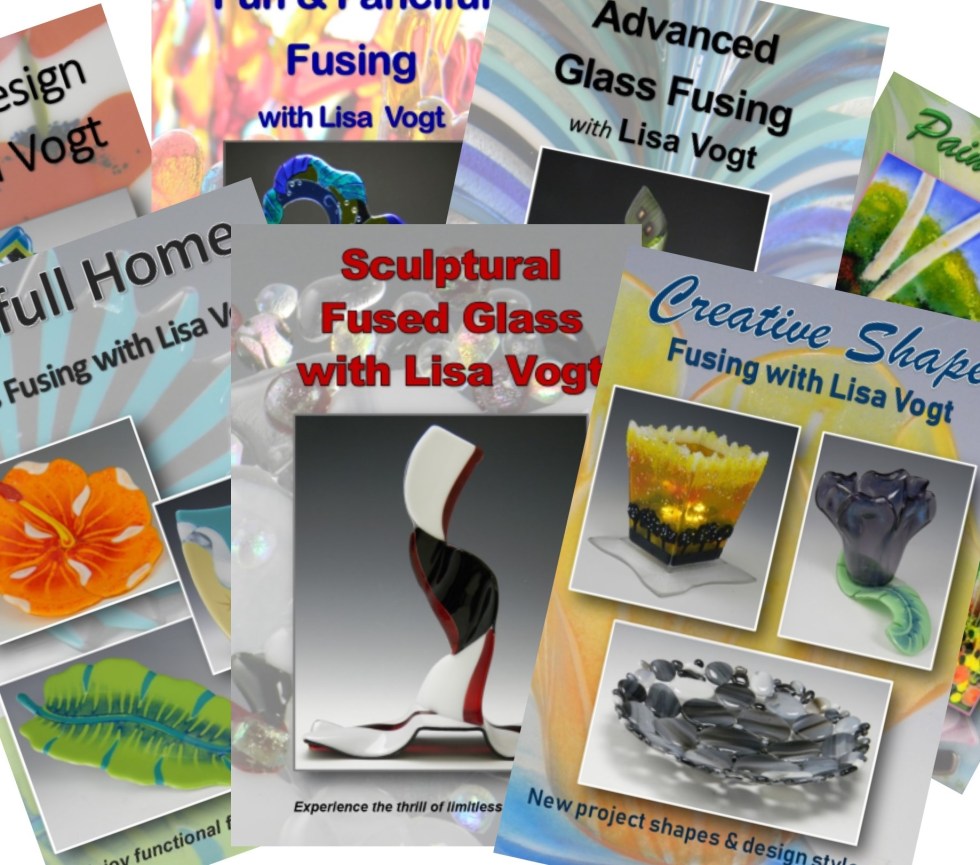
Download instructional videos for every skill level.
Check out my eBooks for elegant patterns and detailed fusing instructions.
Artists are unique individuals. We each have our own special way of approaching our art.
We sometimes use avant-garde methods to get into the creative zone, but once there we’re consumed by the mystery and beauty of the productive energy that flows through us. Being creatives, we don’t want to take time away from our blissful creating to think about how we handle routine tasks like managing kiln shelves, storing molds and glass accessibility. But these tasks, done more efficiently can lead to an increase in your productivity and in the success of your projects.
Work smarter, not harder.
There’s more than one way to approach everything, including how you set up and run your glass studio. I’m going to share how I do things in my studio in hopes that you’ll see some new ways to increase productivity in your studio.
Welcome to my studio. Come in.
My studio is painted happy yellow. I splattered gold paint over the yellow base to give the place a fun, festive feel. Here’s a secret. I was drinking wine while slinging the gold paint, so the application is a little random but still artsy.
I have 8 kilns that I use regularly. I store my ready to use, primed kiln shelves on the floor behind my kilns. I lean the shelves against the wall behind the kiln that they fit in. They’re easy to reach and out-of-the-way so they don’t bet bumped or damaged. Once a shelf has been used, I leave it out and lean it against a rack along with other used shelves. When I have several shelves that need priming, I clear off my worktable, lay the shelves out and prime them all at once. The shelves dry overnight and are then stored behind the kilns.
I use Bullseye primer. I mix it in a bucket with 1 cup dry primer to 4 cups water. I re-prime my kiln shelves after every use.
My worktables are 4 ft. wide x 8 ft. long and 3 ft. tall. The legs are 4 in. x 4 in. thick for sturdy support. These thick legs support heavy weight and the stress of hammering without getting shaky. I store empty cardboard boxes, a shop vac and trash cans under the tables.
I have 2 Skutt clamshell kilns with amazing new state-of-the-art Touchscreen Controllers. I’m still discovering all of the controller’s intuitive features. So far, I love the ease of use and the vast amount of helpful information available at my fingertips, plus the controllers are WiFi equipped. Also there’s an ingeniously designed app so I can monitor my firing progress from anywhere on my smartphone. (Look for more detailed information of the Touchscreen Controllers, and how to use them in a post in the very near future.)
My clamshells have a 24 in. x 24 in. interior with a 13 in. depth. They’re my go-to kilns for making sinks, elaborate sculptural pieces and my high-end commission work. They’re easy to program, even when the programs are complicated with 8 segments and multiple holds. I trust them to give me consistent, reliable results every time.
I also have a Skutt Fire Box 14. It has a 14 in. x 14 in. square interior. You can fit a lot more glass in a square firing chamber than you can in a round chamber. I love using my Fire Box when I’m making single, one-of-a-kind plates, bowls and vases. It’s quick and easy to load plus fast to fire, with pre-programed settings for all my firing needs. I use my 3 reliable small Evenheat kilns to make quick samples and to test-fire new techniques I’m developing.
My largest kiln, which I call Big Blue, or My Cremation Station is a Denver Glass Machinery kiln. It has a 3 ft. x 4 ft interior with a 13 in. depth. I had it custom made to fuse glass kites for an installation at Tampa International Airport.
It has a clamshell style lid that I open and close with an electric winch. It’s the kind of winch used to take motors out of cars. My wonderful hubby mounted it to the ceiling and rigged a cable. It’s fun to raise the lid to see a new successful project completed.
When opening the lid with the electric motor, I sometimes feel like a mad scientist. After a successful firing I think I know the exciting thrill Dr. Frankenstein felt when his masterpiece came to life.
I store my large ceramic sink slumping molds on a shelf under Big Blue. The huge ceramic molds are heavy. From here I can access them easily and only have to carry them a short distance to the kilns.
Large primed stainless steel slumping molds are stored behind Big Blue. They lean against the wall. Here they’re safe. Upright they stay clean and the primer coating stays in good, ready to use condition. Behind the kiln, against the wall, the molds are out of the way, but still easy to access reach needed.
My smaller ceramic molds are stacked on a wire rack with shelves. I don’t prime my slumping molds every time I use them. I prime molds when they show signs of wear. If the coating looks thin or if it’s chipping off the mold, I sand the mold smooth and re-prime it.
I have two smaller wire racks as well. One holds my kiln posts, spare fiber board dams and assorted tools. The other one holds stainless steel floral formers and kiln wash. Glass cutting boards are stored out of the way alongside my cabinets.
My glass grinder, band saw, and ring saw are always ready to use on a counter located along the back wall of my studio. I keep a bucket of clean water next to the grinder so I can fill the grinder and saws as needed.
My glass is organized by color. Sheet glass is held in a wooden rack. Small pieces are stored on top and full sheets are stored in the larger compartment on the bottom. When pulling glass, I try to use the smaller pieces first. I save the full sheets for projects that require longer, larger cuts.
Scrap glass is stored in plastic bins for safe quick and easy access. When working on a project that uses scrap glass, I simply remove the bin with the color I want and carry it over to my worktable. There I can carefully remove sharp pieces without worrying about getting cut.
I have a huge selection of frit. The jars are organized by color. When I’m working on a project, I choose a specific color palette. So, when I go to the shelves to gather jars of fit, I know what colors to pull. I bought my wire racks and rolling carts at Sam’s Club.
My Thin Fire fiber paper roll is hung on the end of one of my worktables. The box it came in is cut to cover the roll. The cardboard protects the roll from damage and keeps the paper from getting dusty. When I need a piece of Thin Fire, I unroll the paper onto the table. There, I measure it to the length I want and then cut it to size with a straight edge and single edge razor blade.
Hand tools like glass cutters, pliers, scissors and such, are stored on a rolling cart near my favorite work area. From my favorite spot I have a great view of the yard and the wildlife that frequents our property. Plus, I’m close to the large overhead door which I like to keep open even in hot or cold weather. When the door is open my workstation is flooded with natural light which thrills my muse and inspires my artistic creativity.
I have a small clip board next to each of my kilns. I call these my cheat sheets. Here I have a list of the programs stored on my controllers. If I change a program, I make a note of it on the page.
My programs fall into two categories, small and custom. A small program is for projects 12 inches in size or smaller, made with two layers of glass, plus accents. Most of my kilns have a small program for full fuse, tack and slump programed into the controller. The remainder of the programs stored are random, custom programs I use to achieve specific results. For example, my clamshell kilns also have sink full fuse and sink slump programs. Big Blue has an extended 5 day program I use to make large-scale cast glass commissions. While my oval kiln has a firing program for painting on glass stored in its controller along with the small programs.
I have other useful equipment and tools stored in my studio as well. There’s a chop saw, and table saw for cutting wood. A sandblasting cabinet and compressor for sandblasting designs on glass. I have 2 – 12” glass grinder/polishers tucked in the corner, plus two wet saws for cutting thick glass which are stored on rolling carts. In addition, I have assorted drills, nail guns and toolboxes filling the shelves on the front wall.
I hope you found my studio tour enlightening. Hopefully, some of these tips will help you increase your productivity and the success of your projects.
Join me for this in-depth workshop held in my private studio.
Wesley Chapel, Florida, 4-Day, Hands-on, Class size is limited.
Sculptural Fused Glass, 4-Day, Hands-on Workshop
October 15-18, 2019
Wesley Chapel, FL
Sign up Today! Class size is limited.
You’re invited to join me for this intense workshop held in my private studio in Wesley Chapel, Florida. Class size is limited to 4.
NEW Class Update and Special Offer.
Register now and for the first time EVER, all class materials are included!
PLUS, you’ll get a FREE Fused Art Design Video DVD.
AND, a professional photo shoot of your completed sculptural masterpieces.
Sculptural fused glass is the creation of three-dimensional forms that rise above a flat plane. Artists create 3-D works by using multiple methods and techniques with complete freedom of materials and process.
In this comprehensive class you’ll learn how to design, build and creatively display multiple stunning pieces of art that reflect your personal style.
You’ll push the boundaries glass imposes. You’ll use innovative approaches to design and combine multiple advanced techniques to construct original sculptural art.You’ll enjoy: the one-on-one instruction, making large scale projects, the well-equipped classroom, and the intimate class size.
Its hard-core fusing in a nurturing, relaxed environment. You’ll love the concentrated, in-depth study and creative momentum you’ll gain while actively producing nonstop, for four consecutive days. You’ll also learn how to design and build custom art glass displays that enhance your original work.
Due to popular demand, I’m now extending the hands-on curriculum to include a professional photo shoot of your completed sculptures.
You’ll leave class with several completed sculptures, a working knowledge of kiln operation and custom project-specific firing guides. You’ll have the design confidence and hands-on experience to rise above and take your work to the next level.
In this detailed Webinar, I’ll reshape the way you slump and drape glass. See how thinking outside the box and using readymade molds in new ways offers numerous and exciting opportunities to produce unique forms.
You’ll learn how to make your own graceful, free-form shaped molds from readily available materials with no laborious measuring or messy mixes needed. Taking you one step further, I’ll show you how to use these different approaches, in combination, to transform ordinary projects into inspiring, sculptural pieces of art!
My approach to my art is universal. Although these images are of people, wildlife and nature, I’m certain that utilizing these same techniques will greatly improve the quality and creative style of my artwork images. And so, I’m taking you outside the realm of glass on a little family vacation detour. This fresh perspective on photography demonstrates how easy it is to control, and even manipulate images to make them emotional charged and super exciting.
Okay, maybe 10,000 pictures since I was given my new camera in May is an exaggeration. But my family, often the reluctant subjects of my curious eye, will back me up.
I can and have easily take 500 – 600 pictures in 15 minutes. It turns out, every day and every outing offers new photographic opportunities. But some days I need a break from viewing the world through a narrow lens and I purposely leave my camera home.
I almost always regret not having my camera at arm’s length. Yesterday for example, I saw Sandhill cranes down the street. The tall, red headed birds are usually very passive. They spend their days walking slowly along the grass shoulder digging in the soft ground for bugs.
But yesterday, one bird in a group of four was swinging it’s head and flapping it’s wings. It kept jumping up off the ground and did a lively dance for the other three birds. On these missed occasions, I try to live in the moment and just enjoy the spectacle for what it is, a beautiful glimpse of nature. Then I assure myself it wasn’t my last chance to capture exciting wildlife pictures. The next time a great picture presents itself I’ll be ready to click away.
The effects setting added a nice touch to this image.
After taking so many pictures, I’ve noticed that keeping some concepts in mind results in significantly better, more emotionally charged images. Following are some great examples taken on our summer vacation. These images demonstrate how a little forethought can improve your pictures.
This similar picture was taken with the auto setting.
Here’s what I learned.
For comparison sake, here’s the camera I’m using. I’m not endorsing this particular camera. But I am suggesting that a better quality piece of equipment with professional grade settings and increased pixels will nurture your artistic style, and drastically improve your image quality. My camera is a Nikon D3500 with 24.2 million pixels. It came with 2 lenses: 18-55mm and zoom 70-300mm.
1 Lighting in EVERYTHING!
I can’t stress enough how much good lighting adds to the artistic value of any image. Lighting creates a mood. Lighting breathes life into still images. Lighting is the single, most important aspect you can control. Use it effectively and you’ll create amazing, personalized images. You’ll immediately notice an increase in the professional quality of your images. The extra effort has such a positive impact that the resulting pictures will leave a more memorable impression.
So, how do you catch and control the ever elusive light?
Once you find an interesting subject and composition move around and take pictures from several different angles. Changing your position can help you enhance the effect of the light you have and add higher contrast with shadows.
A good rule of thumb is to have the sun at your back. Then the strong light won’t create a hot spot in your image and the front surface of your subject will be illuminated.
If you’re taking a sunset or sunrise picture, experiment with your camera’s aperture and try several different settings. Try the effects mode to get more vibrant and artsy versions of the scene. I often take the same picture with auto mode, then effects mode and then manual mode and adjust the aperture for unexpected, cool results. Later, I compare the images and keep the one I like best.
This picture was taken at night, while the sprinkler was on with the effects setting.
For more dramatic affects, take pictures in different conditions. Take them early in the morning to capture long purple shadows and the pinkish hue that fresh sunlight casts on everything. Or take pictures late in the afternoon when the sunshine gives objects a golden glow.
Taking pictures in the rain can also be fun. The movement of the falling water combined with soft lighting can really romanticize an otherwise boring setting. Fog is also intriguing. The subtle tones and soft edges it creates can be useful for setting a peaceful or mysterious mood.
This picture was taken with night portrait mode to increase the image brightness.
2 What if the lighting is gloomy and you can’t change the scene without losing the moment?
You could, of course use your flash. But I find them to be too harsh. The bright white light washes out soft colors and makes everything look hard. And a flash often gives subjects the dreaded, red-demon eyes that threaten to haunt you.
This similar picture was taken with auto mode and I felt it was too dark.
Instead, try changing your camera settings. I used, night portrait mode, it’s the setting of a figure with a star over their head, to take pictures of two adorable dogs under a canopy. You could also try the special effect setting to give the picture a surreal feeling. You don’t have to pay for film, so take as many pictures as you like. Experiment and try new combinations just to see what happens.
3 Zoom in. Get up close and personal.
Go ahead, snap the standard composition of your selected subject showing the complete scene and the entire subject. Get that picture out of the way. Then get artsy. Zoom in and take more pictures. Crop out the unnecessary noise. Fill the viewfinder with intricate detail, rich color and plush texture.
Treat the viewer to your special representation of the scene. In doing so, you share an intimate, highly personal experience. I’m finding that tight, close-ups are more engaging. They stimulate the imagination and invite the viewer to participate. They encourage them to imagine the remainder of the scene and the unique circumstances under which the picture was taken. That’s fun stuff!
This one-in-a-million bald eagle picture was taken with the sport setting.
4 It’s easy to capture pictures of wild animals running away from you. Taking pictures of them looking at you is hard.
Apparently, wild animals don’t like to have a large black tube pointed in their direction. They run. Fast. And friends and family are not impressed with butt images, no matter how exceptional the lighting is.
To be a successful wildlife photographer takes patience. You have to quietly place yourself in the right position. Then you wait for the animal to feel comfortable enough to ignore your presence and go back to their natural routine.
This bald eagle was the subject on dozens of pictures.
I find using a telephoto lens and sport mode helpful. The zoom lens gets you close enough to show detail like feathers and eye color. And sport mode enables you to take pictures is rapid succession. This way you can capture all of the animal’s graceful, live-action movements as they happen.
Hint: When closing in tight with a telephoto lens try to position your subject in the exact center of your viewfinder. When taking pictures in sport mode the camera focus is in the exact center. If your moving subject, like a flying bird, is centered the subject will be crisp and clear. If it’s not centered, the camera focus isn’t in line with the subject and the subject tends to be blurry.
My kids and their cousins living it up.
5 Try to take pictures of people in action to show their personalities.
We all love the group picture of everyone standing in a line with the vacation destination’s beautiful scenery spread out behind them. It’s effective, but not very imaginative. Go ahead and take the same picture everyone else has taken this summer. Get it over with.
Then try something new. You can do better. Try stacking your family and friends in a gnarled old tree. Or have some standing and some sitting on the sandy beach. Have the kids gather on the rustic stairs of the rental cabin or on the tailgate of the family car. Include props that represent the trip like fishing poles or Broadway show tickets. You don’t have to make a big deal out of staging your family. They’ll mutiny if you do. But a little creative positioning adds so much enthusiasm and excitement to the standard family portrait. And once the family sees the entertaining results, they’ll actually look forward to posing for you next time.
This picture was taken with the effects setting.
6 Effects are a lot of fun.
Using the effects mode can really exaggerate a scene and make it more vibrant. It can also be used to focus the viewer’s attention on a specific element, of your choosing, in your picture. That’s powerful!
This similar picture was taken with the auto setting.
That said, I use effects in moderation. The effects mode sometimes causes distortion or it confuses the focus on the subject. To be on the safe side, when I take pictures in the effects mode, I also take it in automatic mode. Then later I review the two images on my computer and keep the one I like best.
The sport setting made this action shot possible.
7 Oh, and here’s a useful tip.
Don’t worry about taking notes or cataloging how you take test pictures. After downloading your images, you can access all sorts of relevant information about each picture. Right click on the image. Then click on Properties. In the General tab you can see the file type, the image size and when the picture was taken. For more in-depth information click the Details tab. Here you can see what F-stop, Exposure time and ISO speed you used. You can also see if a flash was used and other helpful information. If you like certain results, use this information to duplicate them on another picture.
Note: I’m using a PC with Windows 10. My pictures are stored in the Pictures folder. If you’re using a different system you may have to search for this information, but I’m certain it’s there.
Just getting started.
8 Here’s a huge time saving tip for sorting your favorite pictures.
If you already know how to do this, good for you! Feel free to skip this part. But, if this is new for you, this is a game changer!
It’s a bit embarrassing to admit I just learned this incredibly useful trick. Especially considering the massive number of pictures I take for my videos, website, social media and for fun. My daughter showed me this trick when I asked her to pick the best images from our family vacation. The take-away is, no matter where you are or what you do, there’s always something new learn.
Here’s the picture grouping trick my daughter showed me.
Bring your pictures up to full size one-by-one. Check to see if you like the composition, the focus and lighting. If it’s a keeper click on the heart icon at the top of the page. Click the heart on all the images you like. When you’re done, go back to the thumbnail screen. Then click on View. Then click on Group By and select Rating. All of the pictures you gave a heart will be grouped at the top of the folder. Then you can look through the grouped images and sort them further picking the very best images. At any time, you can remove the heart and the image goes back to the bottom of the folder. Or you can go back and add a heart to any image to move it to the top group.
If your system works differently, don’t worry. Try clicking around. It’s likely your system has a similar feature, it’s just a matter of finding it and using it.
Yup, I can cut more than just glass.
9 Get in the picture.
Make sure you’re in some of the pictures. It may not seem important now. But when you look back it’ll remind you of the fun you had taking great pictures. And you’ll recall the cherished time spent relaxing with family and friends.
The big one got away.
10 My last bit of advised is this.
Don’t hold back. Set your imagination free and take lots of pictures. I’ve realized that if I’m compelled to take pictures of a single subject over and over, it’s because the lighting, composition or cropping could be better. Once the magic combination is achieved, I’m content to replace my lens cap and just enjoy the scenery.
The effects setting gave this picture a romantic flare.
Vacation is wonderful! I’m always rejuvenated by extended excursions outside of my glass studio. These refreshing departures from “work” inspire new design ideas and artistic directions. Now that I’m back I’m ready to channel my renewed energy back into creating exceptional art.
Here’s a similar picture taken with the auto setting.
I hope you find value in these little tips and they lead you to new creative discoveries in your glass studio, as well as outside.
You’re invited to join me for this intense workshop held in my private studio in Wesley Chapel, Florida. Class size is limited to 4.
Sculptural fused glass is the creation of three-dimensional forms that rise above a flat plane. Artists create 3-D works by using multiple methods and techniques with complete freedom of materials and process.
In this comprehensive class you’ll learn how to design, build and creatively display multiple stunning pieces of art that reflect your personal style.
You’ll push the boundaries glass imposes. You’ll use innovative approaches to design and combine multiple advanced techniques to construct original sculptural art.You’ll enjoy: the one-on-one instruction, making large scale projects, the well-equipped classroom, and the intimate class size.
Its hard-core fusing in a nurturing, relaxed environment. You’ll love the concentrated, in-depth study and creative momentum you’ll gain while actively producing nonstop, for four consecutive days. You’ll also learn how to design and build custom art glass displays that enhance your original work.
Due to popular demand, I’m now extending the hands-on curriculum to include a professional photo shoot of your completed sculptures.
You’ll leave class with several completed sculptures, a working knowledge of kiln operation and custom project-specific firing guides. You’ll have the design confidence and hands-on experience to rise above and take your work to the next level.
NEW Class Update and Special Offer.
Register now and for the first time EVER, all class materials are included!
PLUS, you’ll get a FREE Fused Art Design Video DVD.
AND, a professional photo shoot of your completed sculptural masterpieces.
Summer is a wonderful time to enjoy outdoor activities and breath in the beauty of nature. It’s refreshing to be away from my glass studio in environments rich with color, pattern and new scenes. I cherish time cooling off on the water and the exhilaration of hiking in the woods. The outings clear my mind of old design themes, they rejuvenate my spirit and inspire new design ideas.
I may be off work, but my creative subconscious is on duty collecting tidbits that’ll later be integral parts of my new art. I seek exciting new compositions by studying tiny details like the delicate curled shoots of ferns. I imagine the extreme color combinations studying the broad strokes of a spectacular, cotton candy pink sunset. Even familiar settings, seen with renewed artistic curiosity, offer new appeal.
Fairy Tale Forest from my Painting with Frit Video
Fairy tale Forest was inspired by a path I frequently walk in the woods. It’s an enchanted place with specked shade, inviting curves that promise adventure and the musical sounds of nature alive in the brush. Tall pines and century old oaks form a canopy overhead. The cathedral like tunnel makes me feel small, at ease and safe. It’s as if the trees are guarding me with the wisdom of their age. It’s such a magical place, I half expect to see a white unicorn trotting around palmetto bushes.
The truth is the path doesn’t really look like my design. I exercised my artistic license. I designed the art to convey the way I feel, the comfort and joy I have when I’m strolling down the leaf blanketed trail.
I never would have stretched my artistic vision to that extent without the actual experience of walking down that path.
Paradise Bay from my Painting with Frit video.
Paradise Bay was inspired by a favorite lagoon on a lake. Again, the artwork loosely represents the landscape. It’s really a representation of good times and fond memories of time spent with my family.
River Bottom was inspired by the ditch that lines my street. Really. I was walking one morning and noticed the sunlight shining on the water in the retention ditch on my road. The sun pierced through the clear water down to the bottom where it lit up the tiny green leaves of mossy plants. They sparkled like glitter covered light bulbs. It was so captivating I then noticed some lacy tree leaves suspended in time, and the striking shadows of tree trunks stretching across the placid surface of the water. I thought, this is a beautiful scene, how can I render this in glass?
The project looks simple. You have to see it in person, after hearing the story to really appreciate the true beauty and depth of River Bottom. The take away, the invaluable lesson, is that beauty is all around us. We just have to look for it and then let it inspire us to be creative.
Take it outside!
This summer while you’re exploring beaches, mountains and cities open yourself to discovery. Then, when the artistic spark flares, you’ll have an exciting collection of new ideas to fuel what you fire.
Happy fusing,
Lisa
Follow my blog for more tips and tricks!
Painting with Frit is now available as a download on my website.