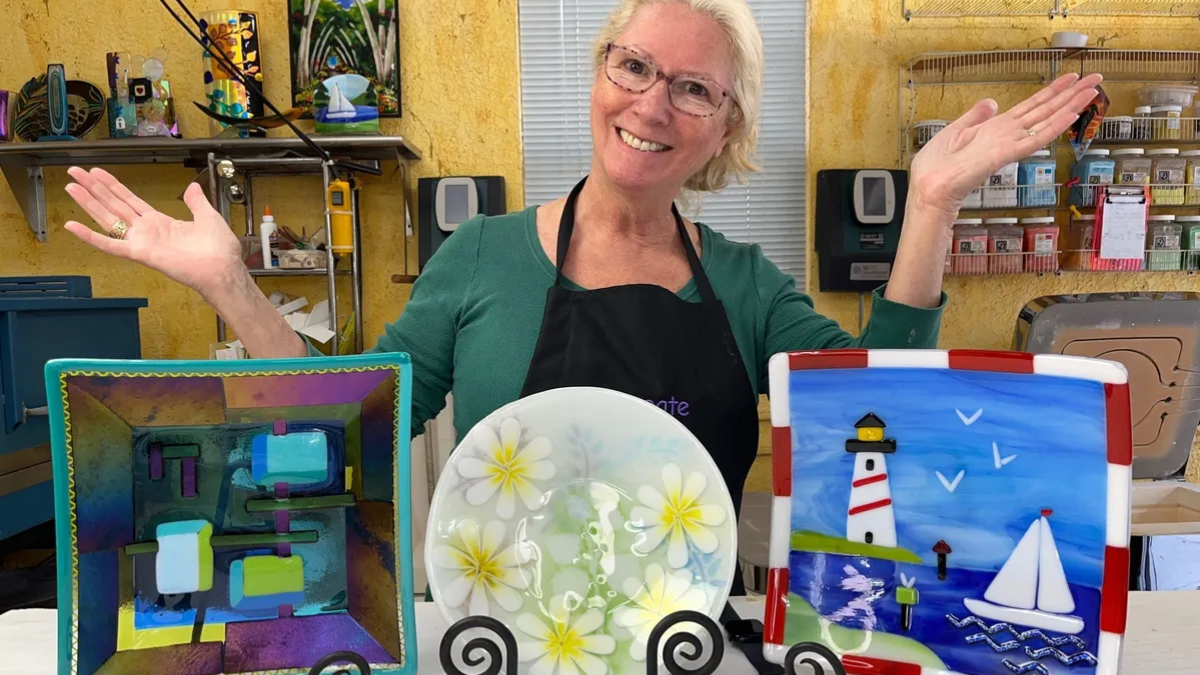
The term creative slumping has a broad range of potential directions. Isn’t that awesome! We have a huge array of handling techniques to feed our ever curious artistic spirit, and challenge our glass crafting skills. For me, creative slumping means taking ready-made molds and using them in ways that result in extraordinarily unique 3-dimensional forms. The great thing about this approach is that super simple ideas applied in combination often make the most exciting pieces of art.
How do you get started?
It’s about looking at your materials with fresh eyes. Because of past experience, you easily envision the outcome of using your favorite molds. But what happens if you place the fused glass on the mold in a different direction? Or maybe next time cut your glass in a different shape? Better yet, use two molds at the same time for a single project. How will that alter your results? The answers are in test pieces.
Nothing goes to waste.
Clear glass is the least expensive glass. When I’m in the mood to experiment with creative slumping I start by planning my project shape. Then I cut that shape out of clear glass. I fuse two pieces of clear glass together, so I have the same thickness I would later when I transition to color glass. Then I test fire the fused glass over my mold configuration taking notes every step of the way. If my results are unexpected or undesirable I try again. Once I have the look I want, I repeat the process with color glass. I keep the clear glass samples that are successful for reference in the future. The ugly samples are broken into mosaic size pieces and used as filler in my cast projects.
If I can’t waste glass who can?
I do a lot of testing. I figure if I can’t afford to waste glass considering how much teaching I do, then who can? I cut the glass, fire the kilns, and make the mistakes, so you don’t have to. Plus, I’m stubborn. I like a challenge. When a project goes wrong, it becomes a personal mission to figure out how to make it right. And I love sharing my processes and giving you the information needed to be successful the first time.
Want to learn more?
That’s what my video Creative Shapes is about. Showing you step-by-step how I come up with my ideas and how I execute them. Plus, I share my project specific firing guides that I’ve developed and tested to ensure your success. If that isn’t enough to convince you to try new shapes, the video projects are striking. Watching flat glass go from a lifeless single plane to a glistening, energetic sculptural work of art is amazingly satisfying.
Join me and take your glass fusing to the next level!
Join me for this intense workshop held in my private studio. Wesley Chapel, Florida, 4-Day, Hands-on, Class size is limited to 4. All class materials re included.
In this class, you’ll push the boundaries art glass imposes. Students will explore innovative approaches to design and combine multiple advanced techniques to construct original art that reflects their own personal style. You’ll enjoy: the one-on-one instruction, making multifaceted projects, the well-equipped classroom, and the intimate class size.
You’ll love the concentrated, in-depth study and creative momentum you’ll gain while actively producing, nonstop for four consecutive days. You’ll leave class with a working knowledge of kiln operation, custom project specific firing guides, and the inspiration you’ve been craving to go bigger and do more elaborate works of fused glass art!
Fusing glass is amazing. We fusers cut glass and super heat it to make cool designs all our own. Solid colors make bold projects, but once you start playing with frit and see all the new and exciting possibilities, you’ll be eager to add this small material to all your big projects.
Frit is crushed fusible glass. Oceanside Compatible frit comes in 5 grain sizes: powder, fine, medium, course and mosaic. Each size is available in 8.5 oz. jars. Each frit size has unique visual characteristics that you can push to ramp up your fused glass projects. Let’s go over the many possibilities one size at a time.
Powder
Powder has the silky consistency of confectioners’ sugar. It appears smooth and has uniform color coverage after fusing. Powder can be used as filler between cut glass pieces, to add shading, to add patterns and even as a repair tool. I use powder when I want super strong color saturation along with multiple color blends.
Shere Power by Lisa Vogt
Shere Power is a great example. Wherever I wanted tight control over my line quality and solid color saturation, I used cut glass to represent the design. The cut glass was fixed to a clear base glass with fuser’s glue. The glue keeps the pieces from moving when applying the frit. Once the glue was dry, I poured powder frit between the pieces and blended the colors with a wide, dry paint brush and a palate knife. The blended powders give the art a beautiful painterly quality that dramatically contrasts with the solid color fields surrounding it.
Other fun uses include using powder to add shadows to a solid base color. Apply medium and dark green powder on top of light green glass to add shading to your design. Or sift the powder over a stencil to add a crisp and intricate pattern to your project.
One of my favorite uses for powder is to fill inconvenient gaps between my cut glass pieces. Think of it like grouting tile. It’s easy and affective. Work a small amount of powder into the gaps with a narrow paint brush. For added pop, use a bright color that contrasts your design’s color palate.
Powder Pros: It’s fast and easy to create subtle or dramatic color blends that support your specific creative vision. Adding shading and pattern is a snap.
Powder Cons: Cleanup is time consuming. The powder requires meticulous cleanup to ensure the surrounding solid glass color isn’t muddied. After removing any excess power with a brush, I go over the surface of the glass with the corner of a damp towel or a damp Q-tip depending upon the size of the surface area being cleaned.
Paradise Palm by Lisa Vogt as seen in Painting with Frit Video
Tips for working with powder.
Don’t be skimpy when you use powder frit. For bright vivid colors, it’s necessary to fill the space between your cut glass pieces to the top edge, in effect making the frit 1/8 inch thick.
Be daring and use high contrast colors, they display better in the finished piece.
Opal glass colors tend to have a more dramatic effect than transparent colors.
Know your glass colors. Powder frit specifically, looks lighter in the jar than the actual glass color. Light blue and dark blue look the same just as transparent light green and opal dark green look the same. If you’re not sure of the intensity or opacity of a powder, look at a larger size frit like, medium or course. Or find a piece of sheet glass with the same color code number, compare it to the frit and the frit color and shade will be obvious.
Powder in high concentration, like in a casting mold, looks milky after fusing. If you want to use powder in a mold, layer it with clear in medium, course or mosaic size frit. Using this technique will improve the transparency of the cast glass project.
Bird of Paradise by Lisa Vogt as seen in Painting with Frit Video
Fine Frit
Fine frit has the consistency of granulated sugar. It appears grainy, like small uniform dots after fusing. Like powder, fine can be used to fill gaps between cut pieces of glass. The larger grain size makes it faster and easier to clean up than powder. Fine is also great for shading when you want a slight textural look to the shadows.
Fine Pros: Cleanup is fast and easy. In the same application, it takes less material to do the same job with fine than it does with powder. Fine is a great filler to use between larger frit. It gives you complete color coverage and prevents the base glass from peeking through.
Fine Cons: Color blends within this same size have a grainy appearance after fusing.
Tips for working with Fine.
Use both transparent and opal glasses for greater visual depth and to create shading.
Use fine frit together with other frit sizes to produce visual textures.
Parrot Fish by Lisa Vogt as seen in Painting with Frit Video
Medium Frit
Medium frit has the texture of course sand. When fused, medium frit retains the sand-like visual appearance. I use this size frit when I want to fill in larger areas with strong color quickly. It can also be used to create shading and color blends provided you welcome variations in the coverage which depend on how much frit or how little frit is applied.
Medium Pros: Medium frit provides you with quick, easy coverage of large areas with strong color saturation.
Medium Cons: This frit has a grainy look, and the base glass may peek through the frit unless your layer is thick.
Tips for working with Medium.
Use both transparent and opal glasses in combination for greater visual depth and to create shading.
Use medium and fine frit together for new color blends and to add visual texture.
Graffiti Bowl by Lisa Vogt as seen in Painting with Frit Video
Course Frit
Course frit has the consistency of small pebbles. The pebble look remains after fusing. This frit is great for filling large areas where you want visual texture to contrast solid fields elsewhere in the project.
Course Pros: Course frit covers a lot of area fast, and it leaves an appealing pattern behind after firing.
Course Cons: The base glass will be visible between this larger size grain.I fill in around course with both medium and fine frit to intensify the color and hide the base.
Tips for working with Course.
Use both transparent and opal glasses in combination for greater visual depth and to create shading.
Use fine and medium frit together with course to produce pleasing textures.
Horse by Lisa Vogt as seen in Painting with Frit
Mosaic Frit
Mosaic has a wide variety of glass shapes and sizes within the jar. This frit leaves a vein-like impression after fusing. I use mosaic size when I have a lot of space to fill and when I want to create an organic pattern.
Tips for working with Mosaic.
Clear glass layered on top of a color dilutes the color below. It’s like adding water to paint. I like to put clear mosaic pieces on top of select elements in my work to create subtle, lighter variations in the original glass color.
During assembly, glue the mosaic pieces down with fusers glue so they don’t move when you fill in the spaces in between.
Use both transparent and opal glasses in combination for greater visual depth and to build interest.
Use fine, medium and course frit to fill gaps and produce interesting color combinations and exciting textures.
Fairy Tail Forest by Lisa Vogt as sen in Painting with Frit Video
Put it all Together.
Frit is a terrific medium for making landscapes or other images where you want to create an engaging depth of field. In nature, objects in the distance are lighter in color, and they visually have less detail. When making landscapes, I use the different frit sizes to emphasize those subtle differences.
I use powder to render the sky because I can get smooth, gradual color changes. I use fine frit to create the tree line and other filler foliage in the distance. The grain size stands out in front of the powder and yet doesn’t compete with the foreground. Medium frit works well for the mid-range elements that require more intricate detail, like bushes or flowers. Course frit is well suited for objects in the foreground, such as flowering plants or sweeping trees. These design elements carry more visual weight and tie the design together. Mosaic frit is great for specific up-close subject matter like a path or bridge. These solid, recognizable focal points lure the viewer into the design.
Oceanside Compatiblefrit comes packed in 8.5 oz. jars. For the larger sizes like course and mosaic you may consider crushing your own frit. The advantage to working from the jars though, is you have uniform sizes within the jars and one single color throughout. Plus, there’s no risk of contaminants like dirt or metal shavings that are present when you crush your own glass. Personally, I prefer to jump right into the design and fabrication phases rather than spend time swinging a hammer and sifting glass.
I hope this round-up entices you to start incorporating frit in your new work. It’s such a versatile and easy to apply material. You will love the creative flexibility it affords.
Want to learn more? Check out my Painting with Frit Video.
Join me and take your glass fusing to the next level!
Join me for this intense workshop held in my private studio. Wesley Chapel, Florida, 4-Day, Hands-on, Class size is limited to 4. All class materials re included.
In this class, you’ll push the boundaries art glass imposes. Students will explore innovative approaches to design and combine multiple advanced techniques to construct original art that reflects their own personal style. You’ll enjoy: the one-on-one instruction, making multifaceted projects, the well-equipped classroom, and the intimate class size.
You’ll love the concentrated, in-depth study and creative momentum you’ll gain while actively producing, nonstop for four consecutive days. You’ll leave class with a working knowledge of kiln operation, custom project specific firing guides, and the inspiration you’ve been craving to go bigger and do more elaborate works of fused glass art!
I’m sharing this Heart of America pattern with you because I’m inspired by individuals who are speaking up and taking action. They demand we never forget who we are and what we stand for. These individuals relentlessly and tirelessly shine light on the truth, what’s at stake and the American way. Thank you!
Making this piece of art made me feel better. It brought me out of a helpless slump, into my studio and into a place of purpose. Cutting the glass, arranging the ground pieces and firing my kiln gave me focus. It sparked action.
This pattern has a story.
This Heart of America pattern has a story. I drew it at a time of uncertainty back in 2001 after 9/11. I offered the pattern to Spectrum Glass who shared it through their publication called, Score. The pattern and resulting glass artwork was a vehicle for glass artists to connect with each other. Artists found comfort and purpose in making the design. They shared the finished flag to show solidarity. Many donated Heart of America to raise spirits and show support for America and all Americans.
The original Heart of America story inspired me to act. Republishing this notable pattern brings us together. I hope it inspires you too.
How-to
This project is fast, fun and easy to do.
For simplicity’s sake, I divided the pattern into three layers. Layer 1 is one single piece cut out of clear glass. Layer 2 is made up of several pieces including the blue field as well as the red and white stripes. Layer 3 is just the star.
Pick glass with purpose.
I selected streaky glass for the red and white stripes to add movement to the waving flag. The blue field is a solid transparent color for greater impact. The star is cut out of solid white to have high contrast on top of the blue field.
Join me and take your glass fusing to the next level!
Join me for this intense workshop held in my private studio. Wesley Chapel, Florida, 4-Day, Hands-on, Class size is limited to 4. All class materials re included.
In this class, you’ll push the boundaries art glass imposes. Students will explore innovative approaches to design and combine multiple advanced techniques to construct original art that reflects their own personal style. You’ll enjoy: the one-on-one instruction, making multifaceted projects, the well-equipped classroom, and the intimate class size.
You’ll love the concentrated, in-depth study and creative momentum you’ll gain while actively producing, nonstop for four consecutive days. You’ll leave class with a working knowledge of kiln operation, custom project specific firing guides, and the inspiration you’ve been craving to go bigger and do more elaborate works of fused glass art!
Advanced fusing is a broad term. What does it mean to advance?
Advancing is moving beyond your current skill level. It’s challenging your abilities and developing your talent and learning how you can make exceptional artwork that exceeds everyone’s expectations.
If this sounds like a huge insurmountable task or an unrealistic goal for you, you’re not alone. Compressed into one sentence, the enormity of advancing ones craft can be a daunting motivation crusher. But don’t worry. Once we break down the steps you’ll be primed, ready and truly excited about taking action.
Here are three top tips pros use to break through and make exhibition quality art.
Black Velvet by Lisa Vogt
1 Be a Master of Color
Color plays an important role in the effectiveness of your art. The colors you select convey your message. You, as the artist have the power to swing the viewers mood from tranquil, bright and cheery to thought-provoking, stirring and stormy. When planning a new project, I consider what type of impression I want to leave and then select colors that support that intention. Reds are active and emotional. Blues are soothing, they suggest tranquility. While yellows represent happiness and contentment. Choose your colors carefully and then use them with purpose to draw the viewer into your magical world.
Daisy Dish by Lisa Vogt & Niki
2 Pick a Pattern
Including patterns in your art is an essential way to increase the visual intricacy and attractiveness of your artwork. The whole idea is to capture interest and hold it as long as possible. Patterns add dimension which increases interest. This entices the viewer and engages them longer. Pattern also shows an increase in artistic exploration and creative skill on your part, and that always gets noticed.
Patterns can be simple and geometric or intricate and organic. I decide how to use pattern based on the artistic style I’m going for. For traditional designs, I like to use structured, linear patterns that illustrate organization and planning. While contemporary designs are great places to use free-flowing patterns. In effect they increase the visual movement throughout the artwork. Whatever style you chose, pattern adds drama that increases the visual quality of any piece.
Crystal Garden by Lisa Vogt
3 Go Sculptural
Shape up. The fastest and simplest way to ramp up your artwork and advance to the next level, is to create a unique shape, and go sculptural. Sculptural pieces always have higher visual impact that translates into an increased perceived value. This is the key to taking your work from a craft or a hobby to the threshold of fine art. We are so fortunate to be working with a medium that we can manipulate and shape any way we want. Take advantage of that and you can transform ordinary into the extraordinary.
Try using slumping molds in different ways. I combine molds to build unique shapes no one else has seen. Or I fuse several small pieces and then glue them together to create a freestanding, three dimensional tower. You can do it too. Start small. Then as you gain confidence go bigger and more elaborate.
Lighthouse by Lisa Vogt
The big difference between making ordinary pieces and repeatedly producing one-of-a-kind original art is planning.
When it’s time to make something new and exciting I begin by asking myself, what style do I want to make. Then I consider what mood the art should provoke and select an appropriate color palate. Then I layout a pattern that will reinforce my selected style. My next step is to plan what form the finished artwork will take. I ask myself, how can I manipulate the shape of the glass and display it in a unique and unexpected way that will be amazing? Then I begin the process of construction.
I don’t always have all the answers at the beginning. But I do follow my original plan to its natural end. Often, new directions present themselves during fabrication, but I stay true to my plan. I’ll take notes on the new possibilities and revisit them later with my next new undertaking. Sometimes deviations are inevitable. Like when an idea or technique fails to produce the results I had hoped. Then I go back to the first three tips, regroup and forge ahead.
I hope this insight helps you overcome obstacles so you can make the art of your dreams.
Learn how to make these pieces of art. Join my Premium Video Membership!
Big Thanks!
I wanted to take a moment to tell you I appreciate your time and your dedication to your art. If you’re here reading this blog every week you are growing artistically and your participation in our community makes it better for all of us.
Wherever you are in your artistic journey, you’re doing a great job! Keep going. Never settle. You are an amazing talent. Shine on!
Happy Fusing!
Lisa
Follow my blog for weekly inspiration sent to your inbox!
Join me and take your glass fusing to the next level!
Join me for this intense workshop held in my private studio. Wesley Chapel, Florida, 4-Day, Hands-on, Class size is limited to 4. All class materials re included.
In this class, you’ll push the boundaries art glass imposes. Students will explore innovative approaches to design and combine multiple advanced techniques to construct original art that reflects their own personal style. You’ll enjoy: the one-on-one instruction, making multifaceted projects, the well-equipped classroom, and the intimate class size.
You’ll love the concentrated, in-depth study and creative momentum you’ll gain while actively producing, nonstop for four consecutive days. You’ll leave class with a working knowledge of kiln operation, custom project specific firing guides, and the inspiration you’ve been craving to go bigger and do more elaborate works of fused glass art!
There’s an enormous number of wonderful existing patterns designed for stained glass that can easily be adapted to fusing.
NEW Pattern eBooks by Lisa
What’s the difference?
The big difference is stained glass patterns have more lines because the glass pieces must be cut to fit next to each other like a puzzle. Fused glass patterns can be simpler with fewer lines because we don’t have to fit the pieces together side by side. We have fewer lines because we layer the glass pieces and stack them on top of each other.
When considering using a stained-glass pattern for fusing visually select an area of the design that you find attractive. Maybe it’s a flower, a butterfly or a geometric shape. Focus on that small area and imagine making it with fewer pieces. You’ll preserve the beauty and energy of the subject by fabricating it with a different technique.
Enjoy unlimited artistic and design possibilities. Stretch outside your comfort zone and make striking artwork that reflects your style.
Pattern from Tropical Teasers Pattern eBook
The options are limitless.
The concept of repurposing designs for different mediums is ages old. Traditional compositions have timeless appeal and are joyfully rediscovered again and again in contemporary artists’ interpretations.
You’ll love having the knowledge and know-how to customize existing professionally designed patterns to suit your artistic vision. Learn how easily you can transform classic compositions into new fresh favorites.
There are many ways to enjoy existing patterns that were originally intended for one purpose and use them for a different type of craft. Applying this multi-function approach to your fused glass greatly increases the number and variety of wonderfully rich patterns available to you.
How to resize patterns for fusing.
These guidelines are for MS Word on a PC. I’m sure similar options are available on other operating systems and devices.
TIP: I use several different graphic apps to accomplish what I need to do on a daily basis. There as several ways to approach this task. I’m humbly offering what I hope is an easily accessible method to help you achieve your artistic goal. If you see an easier path, go for it. My goal is to give you options.
1 Double click on the eBook PDF file to open it on your computer. Preferably a computer that’s connected to a printer.
2 Scroll to find the pattern you want to use.
3 Using the magnifying glass tool with the + sign enlarge the area of the pattern you want to use.
4 With the pattern up on your screen, type Snipping Tool in your Search bar on your computer.
5 Take a screen shot. Click + New. Drag the crossbars over the area you want to copy.
6 Click on the square save option in the upper right-hand corner. Tip: It takes a second to appear. Save the image to your computer in a file folder with the eBook.
7 Open MS Word. Open a new blank document.
8 Click Layout > Margins > Narrow to give you a large canvas and large printable area.
9 Click Insert > Text Box > Draw Text Box. Draw a text box that fills the page. Tip: Drawing a text box allows you to move the box to the middle of the page where it’s easy to adjust the size and make changes.
10 Click inside the text box. Click Insert > Pictures > Insert Picture From this device. Browse to find your screen shot picture of the pattern. Click on the picture and click Insert
11 Drag a corner of the picture to fill the text box.
12 Sizing the picture. Click on the Picture Format to select the picture. Click on the dropdown arrow under Crop > Crop to Shape > Click the Circle shape or Rectangle for a rectangle or square pattern shape.
13 Click on Picture Format > Picture Border. Select black to add a border so you can see the size and shape of your pattern.
14 Click on your pattern design to select it. Click on the down arrow under Crop > Aspect Ratio 1:1 This makes the pattern design dimensions symmetrical. This is good for a circle or square.
15 Next to the Crop option is Height and Width options. Select the Height and replace the dimension with 8 for an 8-inch circle. Click Enter to set your selection.
16 Ta Da! You have a usable pattern for your next fused glass project.
17 Print a test pattern on 8.5 x 11 paper on Portrait mode. Measure the printed pattern to check for accuracy. Adjust your settings if needed.
Pattern from Garden in Bloom Pattern eBook
Line quality.
Depending on the line size and quality of the original design your new pattern line quality may be bulky. Don’t worry. It won’t have an impact on the quality of your fused glass art. Just cut the pattern into the smoothest shapes you can. Don’t let a heavy line keep you from enjoying the infinite number of new pattern ideas that are available to inspire your creativity.
More options.
Another way to alter the pattern size is with your printer settings. Play around with this to get the results you want.
Take a photograph of a pattern. Import the image into your computer to adjust.
Scan a printed pattern to capture the essence of the design. Then make changes to make it your own.
Copyright Laws.
Read the design owner’s copyright guidelines before copying a pattern or design. Pattern book authors may allow you to copy and use their designs for personal use. Ask the copyright owner for permission to use their material before getting started.
Excerpt from Tropical Teasers Pattern eBook & Garden in Bloom Pattern eBook.
Join me and take your glass fusing to the next level!
Join me for this intense workshop held in my private studio. Wesley Chapel, Florida, 4-Day, Hands-on, Class size is limited to 4. All class materials re included.
In this class, you’ll push the boundaries art glass imposes. Students will explore innovative approaches to design and combine multiple advanced techniques to construct original art that reflects their own personal style. You’ll enjoy: the one-on-one instruction, making multifaceted projects, the well-equipped classroom, and the intimate class size.
You’ll love the concentrated, in-depth study and creative momentum you’ll gain while actively producing, nonstop for four consecutive days. You’ll leave class with a working knowledge of kiln operation, custom project specific firing guides, and the inspiration you’ve been craving to go bigger and do more elaborate works of fused glass art!