

Posted on Leave a comment

How to Create Shadows and Shading

You’re wondering why is this subject important? You’ve likely had success working some element of shading into your pieces and that’s great. However, you may not know about the seldom discussed advanced techniques experienced artists use to produce more sophisticated compositions. With thoughtful planning, you can apply these simple techniques and drastically increase the richness of your work.      

When creating shading, it’s natural to reach for black frit or black glass. Black efficiently separates the foreground from the background. Black is also great for outlining your subject. However, there’s a better solution that adds richness to your scene.

When you use black to make shadows it creates a visual hole in your work. This void pulls the viewer’s attention away from your composition. For this reason, I use black as little as possible. I apply it with purpose for specific details in my designs. Instead of black, I use very dark blue, chocolate brown, deep purple or ruby red to make shadows in my pieces. I select the dark color that best suits the color scheme in my artwork. Using powerful high contrast colors adds velvety depth and an incredible richness to the setting.

How to create shadows with color.

Wine Glass as seen in my Simple Pleasures Video

Here I used dark blue to establish the linear details that translate into a grape vineyard behind the wine glass. The deep shadows the blue color creates, give the scene a relaxing late afternoon mood. The border is dark purple which mimics the color of grapes and wine.

Octopus Tray as seen in my Premium Video Membership

Here I used dark red to make shadows on the underside of the octopus tentacles. This application also makes the tentacle visually round and full. Dark red also worked beautifully to outline the octopus body and place it in front of the tentacles that curl behind its body. The only black in this piece is the eye detail.

Fairy tale Forest as seen in my Painting with Frit Video

There’s no black in this lush scene. The dark shadows in the trees and along the path are made with dark blue. The shadow cast on the woodland path is a combination of purple and dark amber frit. Get creative with your color combinations to build up dark recesses that make your highlighted details pop.

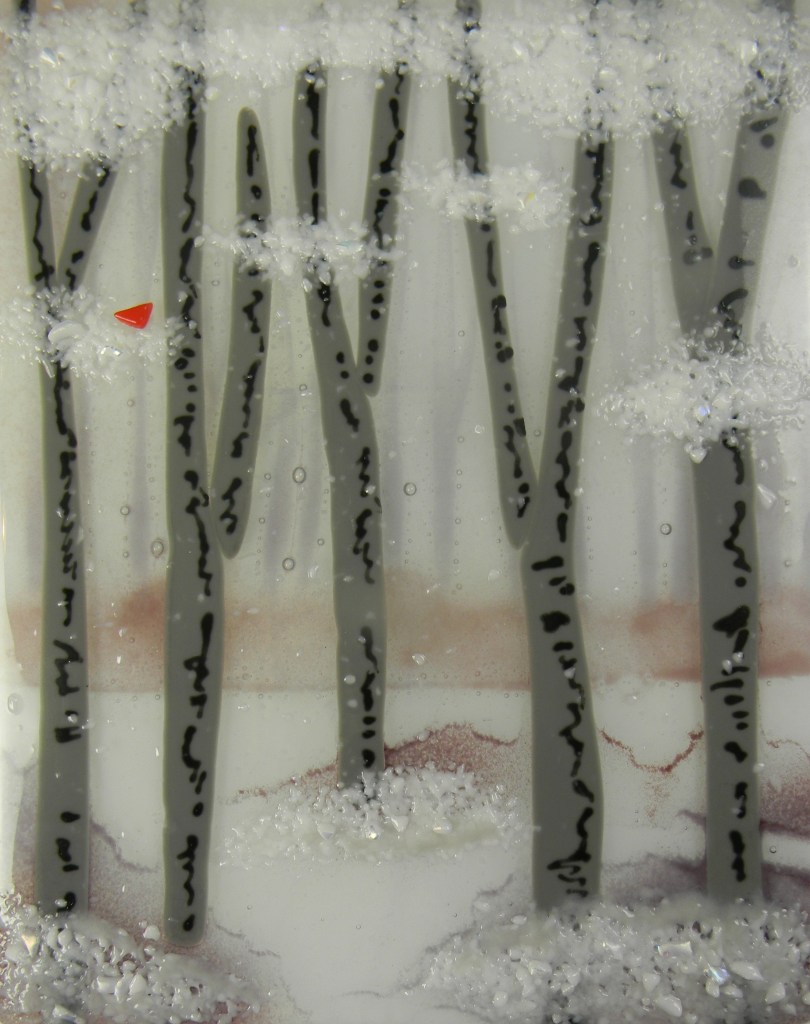
Winter Landscape as seen in the winter issue G.P.Q. Magazine Jan 2023

In this piece of art, black is limited to the lines on the tree trunks. I selected muted tones to create a quiet, calm, and relaxing setting. The shadow under the trees are created with medium purple frit. It simultaneously gave me depth and softness which I wanted to portray in this winter scene.

Welcome Fall as seen in my Premium Video Membership

When making this seasonal piece I wanted to maintain a warm yet rich color palette. I used a small amount black in the word welcome and in some of the letters that spell out FALL. When it came to adding shadows to the pumpkin, I used orange opal frit. The contrast is subtle but effective. I’m pleased with the stylized design and the inviting warmth it adds to my home.  

You got this!

Don’t worry about missing black. Once you substitute colors for black, you’ll love the effects you’re able to create. You’ll be amazed how switching to dark colors transforms your art and brings it to life.

Artists take what they see and make it new.

We take an ordinary scene and turn it into something new that reflects our sense of drama and whimsy. Using rich colors, instead of black, is a fabulous way to push designs in any direction you want to establish a personalized mood and tone. Give it a try. The possibilities are endless. You’re only limited by your imagination.

Watch the video here.

Follow my blog for weekly inspiration sent to your inbox! 

Happy Fusing!

Lisa & Niki

Premium Videos by Lisa


Get your Artwear!

Posted on Leave a comment

5 Tips to Better Glass Cutting

Be a Cut Above

One of the fastest and easiest ways to improve your fused glass art and dramatically expand your design style is to develop your glass cutting skills.

The beauty of working with fusing is the simplicity of the medium. Many people come to the craft with little or no glass cutting experience. Due to the ease of fabrication and wealth of readily available information, they’re successfully producing attractive pieces from the start.

But if you’re now tiring of the simple cut and assemble methods that got you started and longing to move in a more advanced direction, a small dose of technique is the jump start you need.

It may seem like a trivial topic to address, but your project complexity is in direct relation to your cutting confidence. In other words, the better you cut, the more likely you are to venture outside of your comfort zone and take on more challenging projects.

Here are some tips to get you started. 

1 Consistent pressure.

Contrary to popular belief, it doesn’t take a heavy hand to make a good score line on glass. What it takes is consistent, medium pressure from the very beginning to the very end of the score. The glass cutter should, “sing” as it rolls over the surface of the glass. It’s a pleasant, consistent sound beginning to end. It’s not a cringing grinding noise. A good score is visible its entire length. But it’s not messy and littered with thin splinters. The grinding noise and splinters are signs you’re applying way too much pressure.

Many beginners start strong but let up the pressure as their hand moves farther away from their body. In this case, breakage tends to occur ¾ of the way down the score line. Beginners believe the score comes solely from the hand. A good score comes from making your wrist, elbow and shoulder one rigid tool. This combined strength and rigidity helps you apply consistent pressure the entire length of the score even at an awkward distance from your body. 

When cutting an unusually long piece, I turn the glass so I can run my score right to left instead of away from my body. This way I can move my body along with my hand and more easily maintain the consistent pressure needed for a successful break.    

2 Cut on the smoothest side of the glass.

In some cases, I prefer the look, color or pattern on the textured side of a sheet of glass. I turn the glass over and cut on the smoother side and then simply turn the glass back over when I assemble my project. The glass cutter wheel will have better, more consistent, contact with the glass the entire length of the score if you cut on the smoothest side. 

3 Beginning and end.

Try to start your score as close to the leading edge of the glass as possible without falling backward off the glass. Apply consistent, medium pressure from the very start. End the score as close to the far edge as possible without falling off the glass. Repeatedly falling off the glass edge will damage the cutter wheel and could possibly cause the glass to shatter.  

4 Use the right tool for the job.

Use a strip cutter or circle cutter when applicable. Accuracy is key for professional quality artwork. These tools give your work consistency. Plus, they save material by reducing waste and breakage.

When cutting strips, I cut a few more than I need and select the best, straightest strips for my project. The extra pieces find their way into smaller projects, pot melts or free flows. Nothing goes to waste.

Whenever possible, I opt to use running pliers over grozing or breaking pliers to break glass away from a sheet. Running pliers give the most reliable results. They work best if the glass being removed is at least as wide as the rubber tipped plier jaw. When breaking narrow or small curved pieces away, I choose grozing plies because the narrow jaw fits in tight places and allows me to get close to the score line.     

5 Use paper patterns.

Don’t hesitate to cut around a paper pattern to include an intricate shape in your work. This is a terrific way to transition away from strictly geometric designs and into pieces with lively organic elements.

Glass wants to break in a straight line. To cut rounded shapes, we make a series or gradual curves and break the excess glass away in steps until we have a glass shape that closely resembles our pattern.  

When cutting around a paper pattern piece, cut as close to the paper as possible without running into it. Beginners tend to cut a wide safety halo around the paper. It just postpones the inevitable. Be brave. Go for it. If the glass is going to break unfavorably the halo, no matter how heavenly, won’t prevent it.

Something to build on.  

The more time and effort you put into each step makes the next step easier and the finished product that much better. Don’t rush a project just to get it in the kiln. Give it the time it needs and produce your best work, every time. If you have to ask, “Is this good enough,” it probably isn’t. Do yourself a favor, re-do that piece or step. You can thank me later when you’re doing the, my piece came out awesome, happy dance.  

Go ahead. Cut it up!

Happy fusing!
Lisa & Niki

Get FREE advanced glass fusing tips and trick in your inbox. Follow my blog for weekly inspiration.

Artwear T’s by Lisa Vogt

Artwear Designed for Artists by Artists Tell them how you really feel with bold T-shirts, Eco-conscience tote bags and sassy mugs.

Artwear Eco-totes by Lisa Vogt
Artwear Mugs by Lisa Vogt

Get it now! Start fusing today!

Downloadable instructional videos for every skill level.

Instructional eBooks for every skill level.

Posted on Leave a comment

It’s No Mystery – 10 Ways to Create Great Artwork

Great fused glass artwork is no accident. It’s meticulously planned, skillfully executed and artistically presented in an aesthetically pleasing way. Exceptional artwork is the product of several elements. When combined they engage and captivate the viewer. 

These key characteristics are present in all great art. Keep them in mind when designing new work. Apply them when possible, and you’ll immediately see a powerful rise in the quality of your finished art.

How to create great artwork.

Mediterranean Shift from Advanced Glass Fusing Video

1 Design a pleasing composition.  

Composition refers to the placement of design elements within the artwork. By placing elements in a triangular fashion, you create wanted tension viewers find irresistible. Unless the pattern is a geometric grid, I avoid having elements in a straight line vertically or horizontally, it lacks fire.    

Dicro Dishes from Advanced Glass Fusing Video

2 Select an appealing color palate. 

Pick a color palate and stick with it. This shows artistic planning which increases the continuity of the work. When deciding on colors, I pick a setting and then choose colors appropriate for that landscape. For example, if I select a New England Shore as my setting I’d use soft celery green, medium blue, light amber and earth tones. Whereas, a Caribbean beach setting would call for vivid Amazon green, aqua blue, bright yellow and white.

Pisces from Advanced Glass Fusing Video

3 Engage the viewer with a focal point.

I believe all designs even geometric patterns can benefit from having a focal point. A focal point is something of interest that stands out from the background. It anchors the viewers eye and engages their imagination longer than the same piece with no focal point. It can be as simple as a high contrast color, a unique shape or an unexpected line.

Carnival Flow from Advanced Glass Fusing Video

4 Add visual or physical texture.

Texture invites discovery. It adds a third dimension that amps up the visual intricacy and perceived value of artwork. Include texture and your work will jump off the page.  

Moss from Advanced Glass Fusing Video

5 Add pattern.

Pattern is a terrific way to dress up basic shapes to make them more unique and appealing. It’s also a great tool you can use to reinforce a specific design theme. For example, a basket weave pattern would be a nice addition to a design featuring bamboo shoots. Likewise, brightly colored straight lines could be used to represent a towel that enhances a tropical beach scene. 

Arctic Freeze for Advanced Glass Fusing Video

6 Combine advanced techniques.

Combining techniques is fun and adds dramatic interest to fused glass art. Even simple applications deliver high impact results. Create several component pieces. Try arranging them in several different ways until one makes each piece more interesting than it was alone.   

Tropical Tango by Lisa Vogt

7 Design dramatic imagery.

Including dramatic imagery is a great way to make art memorable. Give the viewer a solid pictorial subject to digest. It’ll grab hold of them and not let go. Viewers easily connect with recognizable focal points.

Grape Tulip from Creative Shapes Video

8 Give your work an exciting shape.

Break free from the confines of expected shapes. Color outside the lines. Offer us a fresh new profile. It’s easy to notch or bump out a square. Add a curved edge to a rectangle. Scallop the outside of a circle. Your work will approve.

Envy from Advanced Glass Fusing Video

9 Give your work sculptural form.

This is the single most effective way to elevate your work from craft to fine art. Combine different slumping molds to create a unique freestanding shape all your own. Or build a mold by draping fiber blanket over kiln posts. The possibilities are endless.

Reflection form Advanced Glass Fusing Video

10 Follow through with a unique display.

You have a vision for your art. Carry that enthusiasm to the end. Consider making a display stand that contributes to the artwork’s energy and makes it impossible to forget. 

In the end, we want to connect with the viewer through our art. We want to stir emotion, deliver a message or fascinate their sense of wonder. Whatever your intention, a well-planned project made with insightful design theories will make your artwork great! 

For more in depth instruction check out my Advance Glass Fusing Video.

Not all projects are pictured here.

Follow my blog for weekly inspiration sent to your inbox! 

Happy Fusing!

Lisa & Niki


Premium Video Courses by Lisa


Posted on Leave a comment

Create Visual Excitement with Pattern & Shape

Pattern and shape are two of the simplest elements that can easily be manipulated to dramatically increase the appeal of fused glass art. By adding unique patterns and building new shapes you can draw the viewer in and lock their attention tight. In the end, isn’t that our goal, to inspire people with our art?

You’ve enjoyed success making the usual plates, bowls and vases following practices and guidelines laid out by the experts. But the element of surprise and the thrill of the unexpected success has gone missing. If you find yourself blindly staring at the glass wishing for inspiration, then it’s time to break the rules. Make art that excites you again.

Before you run wildly through your glass studio, be sure to set this excursion up for success. Start by studying finished art that you find attractive. Define what it is about the piece that appeals to you. Is it the shape, the colors, the pattern, or the design? Take that element and put it aside temporarily. Maybe loosely sketch it out on paper for quick reference later. Do this for three individual pieces of art.

Brilliant Bubbles by Lisa Vogt as seen in Fusing For the Adventurous Webinar

Small details can have a huge impact on the visual appearance of your art.

Don’t underestimate the power of minor changes to customary pieces. When trying to navigate a new territory, you’ll have the greatest success if you take what has worked for you in the past and then expand on it to create something all new and unexpected.

Here’s how to get started.

Anchor the viewer’s eye with an interesting pattern. Unexpected bubbles are usually considered undesirable. But when made into a uniform design, bubbles can add a whole new dimension to the glass art. Designing with bubbles is a terrific way to add decoration and a little sparkle. Light dances inside the tiny dome shapes which increases the appearance of depth and the overall intricacy of the finished piece.

Here, I’m using stringers to establish the pattern. They’re placed even distances apart in two directions on a base glass and then capped with clear glass. The cool thing about this technique is the assembly method dictates the placement, size and shape of the bubbles. If the openings between the stringers are square, then the bubbles are round. Rectangular openings result in oval shaped bubbles. While triangular openings give you tear drop shaped bubbles.

Making small, 2” x 2” test pieces will give you an opportunity to try unusual color combinations. It also builds confidence because you know what to expect when you go bigger. The best part of this technique is the possibilities for imaginative designs are endless. Try it. You’ll be blown away!

Black Tie by Lisa Vogt as seen in Sculptural Fused Glass Video

Sculpture romances the viewer.

Sculpture romances the viewer. It pulls them in like a magnet. Give your art unique shape and the viewer will be hooked. With so many fusing materials at your disposal, it’s never been easier to get creative with your art’s profile. The easiest way to get funky shapes is to drape fiber material over an existing slumping mold. Give the fiber paper exaggerated contours by tucking kiln posts or fiber board between the mold and the fiber.

You can also achieve new shapes by combining different ceramic or stainless-steel slumping molds together. Some of my most exciting pieces have been made this way.

If you’re shy to jump in, build a sample out of clear glass. Make the sample the same shape, size, and thickness as the intended project. Clear is the best choice because it’s the least expensive glass. And you can see through it to see where the glass rests on the mold assembly. Then you’re able to adjust the final piece as needed. Plus, there’s no waste. The clear sample can be smashed and used for casting filler. It’s a win, win.    

The wonderful thing about this technique is every piece of glass slumped has a one-of-a-kind flare. They’re making your own personal original. Now that’s exciting! 

Get crazy and combine both techniques and you have a showstopper. The biggest drawback to this in-depth approach is the amount of time necessary to plan an exceptional project. True, not all projects warrant this much effort. But if you work in stages on a few, you’ll find the outcome is extremely rewarding.

Design developer.

Take it a step further and create your own design. Go back to the three pieces of art you studied earlier. Take the three elements that attracted you and combine them with a unique pattern and a sculptural shape. Now you’re on the threshold of greatness!

These are just a few examples of breaking the rules. If you’re ready to rush into your studio, excited about the possibilities, don’t stop here. These techniques have great potential for expansion in so many directions. Take them and run and set your imagination free.   

For more advanced instruction check out my Sculptural Fused Glass Video.

Check out my new video: How to Create & Retain Texture.

Follow my blog for weekly inspiration sent to your inbox! 

Happy Fusing!

Lisa & Niki


Premium Video Courses by Lisa


Posted on Leave a comment

Defy Conventional Thinking and Make Something Amazing in 5 Easy Steps.

Knowledge – Confidence – Inspiration

Weave Bowl Project Video

Start with a unique oval shape.

The oval is an elegant shape traditionally associated with luxury and wealth. It’s a shape that’s easy to make in glass. I honestly don’t know why, we as high thinking creatives, don’t take advantage of its particular attraction more often.

I’ve used the weave technique many times to make square bowls and rectangular lanterns. The openness of the construction, and the playful overlap of colors combined with the fascinating texture all contribute to the charm of the finished piece. I thought to myself, how can I take this winning combination to the next level? The answer of course was to use this simple, but effective technique to make an unexpected oval shape.

Fabricate your piece with a distinctive glass weave technique.

My weave technique is super easy, surprisingly fun to use and produces very effective results. It’s simple. Pick a color palate and cut a series of ¼ inch wide strips of glass. Cut more strips than you think you’ll need to make your project. This way you have extra and won’t have to interrupt the assembly step to cut more glass. I used both transparent and opal glass, plus dichroic glass on clear.

Draw the oval shape on a primed or fiber paper covered kiln shelf. The weave is made with 4 layers of glass strips. I laid my strips out diagonally for added interest. Layout layer 1 leaving plenty of room between the strips for layer 3. Cut the pieces to size. I intentionally cut my pieces to create a fringe edge. Layout the strips for layer 2 in the opposite direction. Leave room between the strips for layer 4. Repeat with layer 3 and 4. Carefully load the kiln shelf and assembled project in the kiln. Fire to a Tack Fuse temperature.

Use the heat of your kiln to create your own custom results.

This project is tack fused together. At this temperature the resulting project retains the woven texture.  The pieces are heated to the point where they stick together, and the bond is strong enough for the project to support its own weight. The attractive textural quality is both visual and physical which makes the piece more engaging. Consider using the tack fuse temperature to add details and accent pieces to fused glass art to introduce another facet of interest. Here, on this weave bowl the tack fuse option really increases the level of sophistication of this piece of art.   

Slump your glass to give it a graceful profile.

Slumping adds elegance and a pleasing three dimensional quality to your fused glass art. The physical texture created by the weave is also greatly enhanced by the gradual curvature of the bowl shape.

Finish with a custom base worthy of your exceptional artwork.

Making a custom stand or base is equally as exciting as making a striking piece of art. It’s rewarding to follow thorough to the natural completion of a project with a display that shows it off. A base gives the art lift which immediately increases the perceived value and visual intricacy of the finished piece. It also allows light to go through the glass and cast reflections that enlarge the overall impression of the art.  Keep the stand or base simple. It should add to the art, not overpower it, or distract from it’s beauty.   

Keep the dream alive!

One of the many things I love about working with glass is the endless design and fabrication options that are available to us. There are an abundance of exciting new approaches waiting for you to discover when you venture down the less traveled path of experimentation. Let’s go!

Happy Fusing!

Lisa & Niki

Follow my blog for weekly inspiration sent to your inbox! 

Tell them how you really feel with sassy mugs, Eco-totes and bold T-shirts!

Downloadable instructional videos for every skill level.