Posted on Leave a comment

Defy Conventional Thinking and Make Something Amazing in 5 Easy Steps.

Knowledge – Confidence – Inspiration

Weave Bowl Project Video

Start with a unique oval shape.

The oval is an elegant shape traditionally associated with luxury and wealth. Itโ€™s a shape thatโ€™s easy to make in glass. I honestly donโ€™t know why, we as high thinking creatives, donโ€™t take advantage of its particular attraction more often.

Iโ€™ve used the weave technique many times to make square bowls and rectangular lanterns. The openness of the construction, and the playful overlap of colors combined with the fascinating texture all contribute to the charm of the finished piece. I thought to myself, how can I take this winning combination to the next level? The answer of course was to use this simple, but effective technique to make an unexpected oval shape.

Fabricate your piece with a distinctive glass weave technique.

My weave technique is super easy, surprisingly fun to use and produces very effective results. Itโ€™s simple. Pick a color palate and cut a series of ยผ inch wide strips of glass. Cut more strips than you think youโ€™ll need to make your project. This way you have extra and wonโ€™t have to interrupt the assembly step to cut more glass. I used both transparent and opal glass, plus dichroic glass on clear.

Draw the oval shape on a primed or fiber paper covered kiln shelf. The weave is made with 4 layers of glass strips. I laid my strips out diagonally for added interest. Layout layer 1 leaving plenty of room between the strips for layer 3. Cut the pieces to size. I intentionally cut my pieces to create a fringe edge. Layout the strips for layer 2 in the opposite direction. Leave room between the strips for layer 4. Repeat with layer 3 and 4. Carefully load the kiln shelf and assembled project in the kiln. Fire to a Tack Fuse temperature.

Use the heat of your kiln to create your own custom results.

This project is tack fused together. At this temperature the resulting project retains the woven texture.  The pieces are heated to the point where they stick together, and the bond is strong enough for the project to support its own weight. The attractive textural quality is both visual and physical which makes the piece more engaging. Consider using the tack fuse temperature to add details and accent pieces to fused glass art to introduce another facet of interest. Here, on this weave bowl the tack fuse option really increases the level of sophistication of this piece of art.   

Slump your glass to give it a graceful profile.

Slumping adds elegance and a pleasing three dimensional quality to your fused glass art. The physical texture created by the weave is also greatly enhanced by the gradual curvature of the bowl shape.

Finish with a custom base worthy of your exceptional artwork.

Making a custom stand or base is equally as exciting as making a striking piece of art. Itโ€™s rewarding to follow thorough to the natural completion of a project with a display that shows it off. A base gives the art lift which immediately increases the perceived value and visual intricacy of the finished piece. It also allows light to go through the glass and cast reflections that enlarge the overall impression of the art.  Keep the stand or base simple. It should add to the art, not overpower it, or distract from itโ€™s beauty.   

Keep the dream alive!

One of the many things I love about working with glass is the endless design and fabrication options that are available to us. There are an abundance of exciting new approaches waiting for you to discover when you venture down the less traveled path of experimentation. Letโ€™s go!

Happy Fusing!

Lisa & Niki

Follow my blog for weekly inspiration sent to your inbox! 

Tell them how you really feel with sassy mugs, Eco-totes and bold T-shirts!

Downloadable instructional videos for every skill level.

Posted on Leave a comment

3 Ways to Develop You Own Design Style

Glass fusing is more popular than ever. The originality and quality of work Iโ€™m seeing in galleries, on websites and in our fusing groups is amazing. With so many enticing techniques to try itโ€™s tempting to copy other artistโ€™s work.

We all want guarantees that our limited time, hard work and expensive materials will produce dependable, beautiful results every time. And so, we play it safe and continually make the same reliable projects. Or we take the easy route and reproduce otherโ€™s work that we find attractive. But, it doesnโ€™t have to be that way. You can develop your own individual design style. By applying a few simple concepts, your finished work and the time spent creating it will be more rewarding and exciting. 

1. Be Original!

Itโ€™s all been done before you argue. How can I be original, you ask? Yes, itโ€™s all been done. But even the simplest techniques seen through your special artistโ€™s lens and executed with your skilled hands can produce all new results.

To advance beyond routine projects begin by examining art that you admire. When you see a piece of art that really speaks to you, study it. Reduce your admiration down to the most basic attribute of the art. What really captures your interest? Is it the color, the shape or the imagery? Take that feature, hold on to it, then put it aside temporarily. Look at another piece of art. Identify the specific characteristic that you find attractive and put that feature aside temporarily. Do this for a third piece of art. Study it until you know exactly what trait appeals to you. Then take those three characteristics and combine them and youโ€™re guaranteed to design your own original art.

2. Shape Up!

One of the fastest and easiest things you can do to make your art stand out is to give it a unique shape.

The most common shape for fused glass projects is the square. Primarily, because itโ€™s economical, thereโ€™s no waste. And, because thereโ€™s very little cutting, it enables you to get right to the fun stuff, building the design. Itโ€™s also popular with beginners and hobbyists with basic cutting skills. By moving away for the square, you immediately increase the visual value of your work.

The rectangle is popular for the same reasons. If you change the shape of your square or rectangle, even slightly, youโ€™re sure to engage the viewer longer.

The circle is traditionally a very pleasing shape. It requires a higher skill level to cut and therefore is more unique. But it also benefits from innovative thinking and a fresh approach to the perimeter shape.

How do you come up with new shapes?

I like to draw quick, no obligation sketches on note book pages. I resist the urge to self-edit or limit the creative flow. The pencil just glides over the paper making a mess of the previously clean white space. The first few sketches usually resemble familiar, safe shapes and designs. But once those are out of my head, suddenly thereโ€™s room to be more creative. All new shapes begin to develop.

During these exercises Iโ€™m free to draw the impossible.

I then take bits and pieces from the shapes that I find interesting and remix them to create my own new, project profiles. And sometimes, if Iโ€™m lucky, I even manage to figure out how to build the impossible ones.

3. Combine Fusible Techniques

Putting it into practice.

The beauty of this approach is the techniques donโ€™t have to be super difficult to have a positive impact on your new work. We all have our favorite, trusted, go-to techniques. Start there.  

Using a complimentary color scheme, make three individual pieces, using three different methods. Cut the pieces up. Reinvent their roles in your art. Move them around. Change the composition a few times. If nothing thrills you, set them aside and let your creative subconscious have a turn.

Donโ€™t force the grouping. I find that once I relieve the pressure to solidify a design, one presents itself. And the new composition is usually one that I otherwise would never have thought of. In cases like this, I believe the physical, ready made pieces guide and influence the discovery of innovative designs. Try it. Youโ€™ll be amazed how this abstract assembly opens your mind to fresh ideas.

Trust yourself.    

Design with confidence. Resist the impulse to compare yourself or your work to others. Instead, blaze your own trail and donโ€™t look back. Take pride in your individuality and what you contribute to the craft.

Take risks to further develop your personal design style. Nurture your unique artistic perspective and your creative spirit will flourish.

Happy fusing!
Lisaย & Niki

Follow my blog for weekly inspiration sent right to your inbox.

Join my Premium Video Course Membership

Artwear T’s by Lisa Vogt

Artwear Designed for Artists by Artists Tell them how you really feel with bold T-shirts, Eco-conscience tote bags and sassy mugs.

Artwear Eco-totes by Lisa Vogt
Artwear Mugs by Lisa Vogt

Get it now! Start fusing today!

Downloadable instructional videos for every skill level.

Instructional eBooks for every skill level.

Posted on Leave a comment

There is NO Always or Never in Glass Fusing

Glass fusers constantly ask me for advice. They want me to give them concrete answers to their questions. They seek the comfort and consistency of solid solutions to all their inquiries.

Itโ€™s just not that simple.  

There are SO many variables. How big is the project? What size kiln is being used, what type of construction are you using? Just to name a few. Itโ€™s impossible to give an accurate assessment of your process without knowing every detail of your specific construction and equipment.  

Iโ€™ve been fusing glass for 38 years. I consider myself experienced, not an expert. I donโ€™t have all the answers. However, I use my years of experimentation to come up with practical solutions for building new projects and to solve unexpected problems.

Be smart. If someone offers, you must do it this way advice, they donโ€™t know what theyโ€™re talking about. Thereโ€™s no way they can take all the unknowns into account and give you valuable guidance.   

Itโ€™s your job as the artist to do your own research.

When you have a question about how to proceed on a project, itโ€™s your job as the artist to do your own research. Find the best practices for you, in your workspace with your materials and then make educated decisions on how to complete the artwork to the best of your ability.     

A comment on one of my YouTube videos prompted this blog topic. The fuser asked if a slumping mold should be placed on kiln posts, instead of the kiln floor, to allow air circulation. This is a perfect example of, it depends. How big is the kiln? Where are the heating coils in the kiln? How tall is the mold?  Optimally, itโ€™s best if the fused glass sitting on the mold is as far away from the heating coils as possible to prevent breakage. If youโ€™re using a deep kiln and thereโ€™s room, sure put the mold on posts. If the kiln is shallow, Iโ€™d place the mold directly on the kiln floor.

It’s okay to take advice and only use the part that works for you. In fact, take lots of advice and make up your own personalized best practices. After all, youโ€™re an artist, apply your creative spirit to the entire process technical facets included.  

You got this!

Follow my blog for weekly inspiration sent to your inbox! 

Happy Fusing!

Lisa & Niki

Knowledge – Confidenceโ€‚- Inspiration

Premium Video Courses by Lisa


Posted on Leave a comment

The Incredible & Amazing Value of Test Firings

Donโ€™t run away screaming! I hate wasting time and throwing material away on test firings just as much as you do. Or at least I used to. But the truth is, youโ€™ll have faster artistic growth and a more expansive set of techniques to work from, if you learn to love test firing.

Make it fun.

Envy from Advanced Glass Fusing Video

When firing a planned project, I tuck a small test piece in the kiln on the corner of the shelf. This way I have the main project to look forward to, and a bonus project to learn from.

I had a sculptural piece of art in mind for years. It was a good fit for my new video, Advanced Glass Fusing, but I didnโ€™t know if I could pull the piece off. In my minds eye, the art curved in apposing directions. It had a strong linear pattern, accented with windows on the tips of three wings. The intricate design represented a lot of time and intense attention to detail.

Before committing to cutting the glass for the design I wanted to be sure I could create the fluid shape I wanted. I made a custom mold by draping 1โ€ thick fiber blanket over a series of ceramic bricks and kiln posts.

The artwork would be ยผโ€ thick. I cut a piece of double thick clear fusible glass to the size and shape of the intended art and slumped it over my custom mold. The slumped shape was close to what I envisioned. But it was too shallow and lacked dramatic flair. I made the mold steeper, giving it a more severe angle.  I also increased the hold time at my conservative slumping temperature of 1220 degrees from 20 minutes to 35 minutes. The second piece of double thick slumped beautifully. The glass had a graceful curve and broad sweeping wings.

When I assembled the intricate pieces to make the artwork I did it with confidence knowing it would be slumped in a way worthy of the effort.

That feeling of artistic freedom was empowering. It also spurred new design directions that drive me to experiment further.

Test firing is valuable on every artistic level, small scale as well as large scale.

Arctic Freeze from Advanced Glass Fusing Video

The project doesnโ€™t have to be bold or revolutionary for you to benefit from testing a new way of construction. When making a piece that would feature a decorative element cut from a combed glass slab, I wanted to include a second pattern that reinforced my color scheme. I fired a small test of the colors I selected. Later, I used that information to create a beautifully detailed pattern blank. The blank was the perfect complement to the combed component.
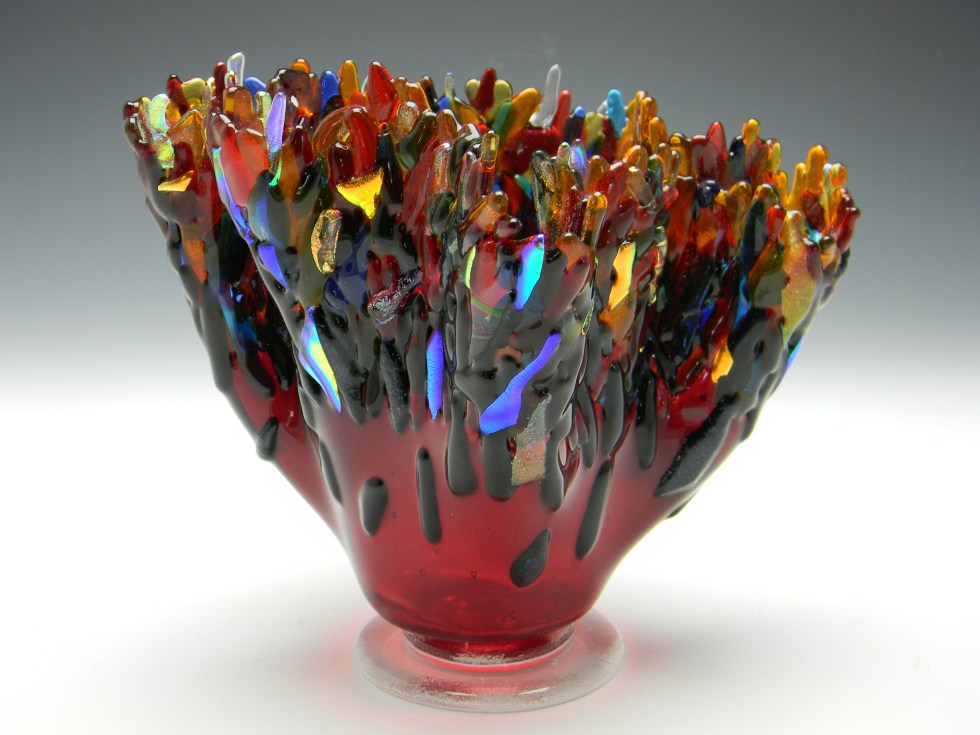
Fire Storm from Fun & Fanciful Fusing Video

Before making Fire Storm for my new video, Fun & Fanciful Fusing I test fired tiny bits of glass. I wanted to determine which temperature would give me the best shiny edge quality, while retaining the irregular shapes I liked. As it turned out, I preferred the look of the pieces after being fired to a slump temperature, not the fire polish temperature.

Even failed tests have value.

A student in one of my classes made a project where they stacked a transparent amber glass on a transparent purple glass. The project was UGLY! But they created a beautiful, Winnie the Pooh brown. Now as a finished project, it was awful. But as a learning tool it was priceless. We now know how to make a rich, warm brown color on demand.

The takeaway is this; test firing is not a waste of time or materials. Itโ€™s an investment in the future of your artistic growth.

Happy Fusing!

Lisa & Niki

Follow my blog for weekly inspiration sent to your inbox! 

Artwear T’s by Lisa Vogt

Artwear Designed for Artists by Artists Tell them how you really feel with bold T-shirts, Eco-conscience tote bags and sassy mugs.

Artwear Eco-totes by Lisa Vogt

Artwear Mugs by Lisa Vogt

Downloadable instructional videos for every skill level.

Posted on Leave a comment

How to Make Fused Glass Pendant Lights

Design, fabrication and installation by Jake and Jessie Battin

I love to watch the dreamy reaction of visitors the first time they visit our home. They look around at my colorful dรฉcor like kids in a candy store. Then, wide eyed they say something akin to, โ€œThis is definitely an artistโ€™s house.โ€ They tell me theyโ€™re amazed how Iโ€™ve incorporated artistic details and functional art into our everyday lifestyle. In my opinion, thatโ€™s the best way to appreciate art, with daily enjoyment of its beauty and grace.  

You can imagine how excited I was when my daughter and son-in-law mentioned they wanted to integrate glass art into their decorating plans for their new house. Of course, they have their own style and color scheme which made the process of designing and fabricating their pendant lights even more fun and fulfilling.

Jessie and Jake have played in my glass studio in the past. But this time was different. They didnโ€™t want us to make the lights for them. Instead, they wanted to design and fabricate the lights themselves. I guided them along the way. We consulted about the size and shape the lights would take. But when it came time to cut the glass and assemble the pieces, they did the actual construction. It was fun to watch them process the cause and affect of the colors they chose and the design style they envisioned. Itโ€™s the same thrill I get when I teach hands-on classes and webinars. Itโ€™s as inspiring for me as it is for the students. I feed off their positive energy and enthusiasm for creating something thatโ€™s both beautiful and functional.

It was especially rewarding to watch them overcome obstacles as they occurred, and then not give up, but stick with the project to the end. Draping glass over a stainless-steel mold often delivers varying results. The size and shape of the glass, as well as the kiln you use all play a role in the outcome. Therefore, I suggested we make a test piece to ensure their glass colors and the finished shape matched their expectations. The test piece proved to be extremely valuable. We all concluded it was ugly, but still very valuable, as learning curves tend to be.

The test piece was even a bit of a surprise for me. Iโ€™ve been working with glass for more than 30 years. It continues to amaze me when the finished piece doesnโ€™t resemble my anticipated vision. Then again, thatโ€™s one of the traits I love about this medium, itโ€™s versatility, flexibility and promise of something new.

The test piece taught us so much. Jessie and Jake decided to eliminate some glass colors that the felt turned muddy after firing. We adjusted the tack fire schedule to give the accent pieces a softer look. And we also adjusted the drape temperature to ensure the pendant lights would have an organic, free form shape.

Yes, it took more time, and we used more material making the test piece. But it has a special significance because it paved the way to the pendant lights that turned out as planned.

The take-away here is simple. No matter how experienced you are, there is more to learn. Donโ€™t hesitate to make test pieces and take notes. Take before and after pictures. The information you gain is valuable. It will give you the confidence to try new ideas and make more advanced pieces of art, and that is priceless.      

Happy Fusing!

Lisa & Niki

Follow my blog for weekly inspiration sent to your inbox! 

Tell them how you really feel with sassy mugs, Eco-totes and bold T-shirts!

Downloadable instructional videos for every skill level.