Posted on Leave a comment

Defy Conventional Thinking and Make Something Amazing in 5 Easy Steps.

Knowledge – Confidence – Inspiration

Weave Bowl Project Video

Start with a unique oval shape.

The oval is an elegant shape traditionally associated with luxury and wealth. Itโ€™s a shape thatโ€™s easy to make in glass. I honestly donโ€™t know why, we as high thinking creatives, donโ€™t take advantage of its particular attraction more often.

Iโ€™ve used the weave technique many times to make square bowls and rectangular lanterns. The openness of the construction, and the playful overlap of colors combined with the fascinating texture all contribute to the charm of the finished piece. I thought to myself, how can I take this winning combination to the next level? The answer of course was to use this simple, but effective technique to make an unexpected oval shape.

Fabricate your piece with a distinctive glass weave technique.

My weave technique is super easy, surprisingly fun to use and produces very effective results. Itโ€™s simple. Pick a color palate and cut a series of ยผ inch wide strips of glass. Cut more strips than you think youโ€™ll need to make your project. This way you have extra and wonโ€™t have to interrupt the assembly step to cut more glass. I used both transparent and opal glass, plus dichroic glass on clear.

Draw the oval shape on a primed or fiber paper covered kiln shelf. The weave is made with 4 layers of glass strips. I laid my strips out diagonally for added interest. Layout layer 1 leaving plenty of room between the strips for layer 3. Cut the pieces to size. I intentionally cut my pieces to create a fringe edge. Layout the strips for layer 2 in the opposite direction. Leave room between the strips for layer 4. Repeat with layer 3 and 4. Carefully load the kiln shelf and assembled project in the kiln. Fire to a Tack Fuse temperature.

Use the heat of your kiln to create your own custom results.

This project is tack fused together. At this temperature the resulting project retains the woven texture.  The pieces are heated to the point where they stick together, and the bond is strong enough for the project to support its own weight. The attractive textural quality is both visual and physical which makes the piece more engaging. Consider using the tack fuse temperature to add details and accent pieces to fused glass art to introduce another facet of interest. Here, on this weave bowl the tack fuse option really increases the level of sophistication of this piece of art.   

Slump your glass to give it a graceful profile.

Slumping adds elegance and a pleasing three dimensional quality to your fused glass art. The physical texture created by the weave is also greatly enhanced by the gradual curvature of the bowl shape.
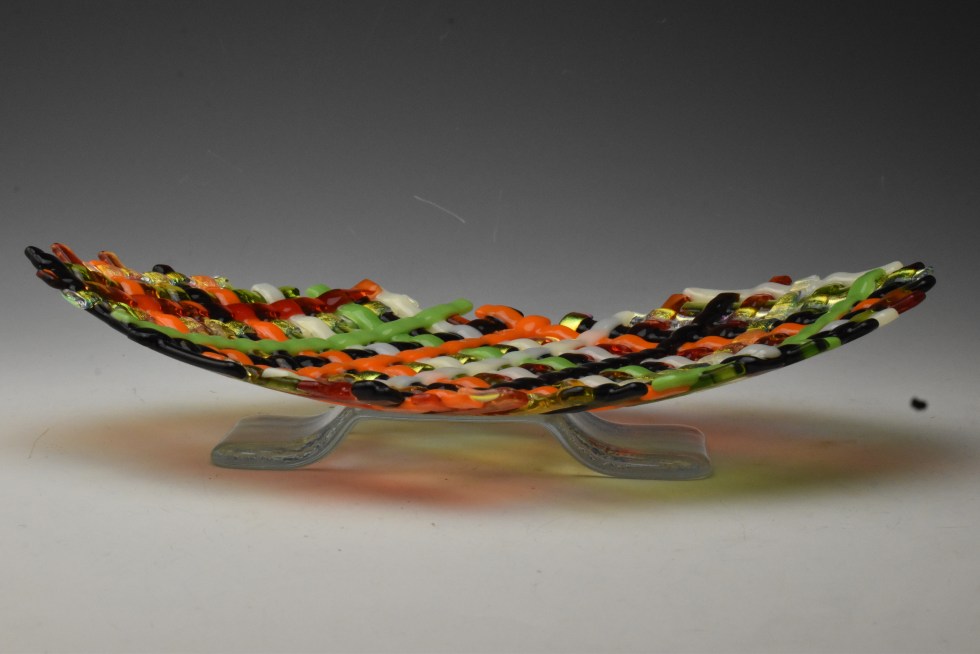
Finish with a custom base worthy of your exceptional artwork.

Making a custom stand or base is equally as exciting as making a striking piece of art. Itโ€™s rewarding to follow thorough to the natural completion of a project with a display that shows it off. A base gives the art lift which immediately increases the perceived value and visual intricacy of the finished piece. It also allows light to go through the glass and cast reflections that enlarge the overall impression of the art.  Keep the stand or base simple. It should add to the art, not overpower it, or distract from itโ€™s beauty.   

Keep the dream alive!

One of the many things I love about working with glass is the endless design and fabrication options that are available to us. There are an abundance of exciting new approaches waiting for you to discover when you venture down the less traveled path of experimentation. Letโ€™s go!

Happy Fusing!

Lisa & Niki

Follow my blog for weekly inspiration sent to your inbox! 

Tell them how you really feel with sassy mugs, Eco-totes and bold T-shirts!

Downloadable instructional videos for every skill level.

Posted on Leave a comment

There is NO Always or Never in Glass Fusing

Glass fusers constantly ask me for advice. They want me to give them concrete answers to their questions. They seek the comfort and consistency of solid solutions to all their inquiries.

Itโ€™s just not that simple.  

There are SO many variables. How big is the project? What size kiln is being used, what type of construction are you using? Just to name a few. Itโ€™s impossible to give an accurate assessment of your process without knowing every detail of your specific construction and equipment.  

Iโ€™ve been fusing glass for 38 years. I consider myself experienced, not an expert. I donโ€™t have all the answers. However, I use my years of experimentation to come up with practical solutions for building new projects and to solve unexpected problems.

Be smart. If someone offers, you must do it this way advice, they donโ€™t know what theyโ€™re talking about. Thereโ€™s no way they can take all the unknowns into account and give you valuable guidance.   

Itโ€™s your job as the artist to do your own research.

When you have a question about how to proceed on a project, itโ€™s your job as the artist to do your own research. Find the best practices for you, in your workspace with your materials and then make educated decisions on how to complete the artwork to the best of your ability.     

A comment on one of my YouTube videos prompted this blog topic. The fuser asked if a slumping mold should be placed on kiln posts, instead of the kiln floor, to allow air circulation. This is a perfect example of, it depends. How big is the kiln? Where are the heating coils in the kiln? How tall is the mold?  Optimally, itโ€™s best if the fused glass sitting on the mold is as far away from the heating coils as possible to prevent breakage. If youโ€™re using a deep kiln and thereโ€™s room, sure put the mold on posts. If the kiln is shallow, Iโ€™d place the mold directly on the kiln floor.

It’s okay to take advice and only use the part that works for you. In fact, take lots of advice and make up your own personalized best practices. After all, youโ€™re an artist, apply your creative spirit to the entire process technical facets included.  

You got this!

Follow my blog for weekly inspiration sent to your inbox! 

Happy Fusing!

Lisa & Niki

Knowledge – Confidenceโ€‚- Inspiration

Premium Video Courses by Lisa


Posted on Leave a comment

How to Make Fused Glass Pendant Lights

Design, fabrication and installation by Jake and Jessie Battin

I love to watch the dreamy reaction of visitors the first time they visit our home. They look around at my colorful dรฉcor like kids in a candy store. Then, wide eyed they say something akin to, โ€œThis is definitely an artistโ€™s house.โ€ They tell me theyโ€™re amazed how Iโ€™ve incorporated artistic details and functional art into our everyday lifestyle. In my opinion, thatโ€™s the best way to appreciate art, with daily enjoyment of its beauty and grace.  

You can imagine how excited I was when my daughter and son-in-law mentioned they wanted to integrate glass art into their decorating plans for their new house. Of course, they have their own style and color scheme which made the process of designing and fabricating their pendant lights even more fun and fulfilling.

Jessie and Jake have played in my glass studio in the past. But this time was different. They didnโ€™t want us to make the lights for them. Instead, they wanted to design and fabricate the lights themselves. I guided them along the way. We consulted about the size and shape the lights would take. But when it came time to cut the glass and assemble the pieces, they did the actual construction. It was fun to watch them process the cause and affect of the colors they chose and the design style they envisioned. Itโ€™s the same thrill I get when I teach hands-on classes and webinars. Itโ€™s as inspiring for me as it is for the students. I feed off their positive energy and enthusiasm for creating something thatโ€™s both beautiful and functional.

It was especially rewarding to watch them overcome obstacles as they occurred, and then not give up, but stick with the project to the end. Draping glass over a stainless-steel mold often delivers varying results. The size and shape of the glass, as well as the kiln you use all play a role in the outcome. Therefore, I suggested we make a test piece to ensure their glass colors and the finished shape matched their expectations. The test piece proved to be extremely valuable. We all concluded it was ugly, but still very valuable, as learning curves tend to be.

The test piece was even a bit of a surprise for me. Iโ€™ve been working with glass for more than 30 years. It continues to amaze me when the finished piece doesnโ€™t resemble my anticipated vision. Then again, thatโ€™s one of the traits I love about this medium, itโ€™s versatility, flexibility and promise of something new.

The test piece taught us so much. Jessie and Jake decided to eliminate some glass colors that the felt turned muddy after firing. We adjusted the tack fire schedule to give the accent pieces a softer look. And we also adjusted the drape temperature to ensure the pendant lights would have an organic, free form shape.

Yes, it took more time, and we used more material making the test piece. But it has a special significance because it paved the way to the pendant lights that turned out as planned.

The take-away here is simple. No matter how experienced you are, there is more to learn. Donโ€™t hesitate to make test pieces and take notes. Take before and after pictures. The information you gain is valuable. It will give you the confidence to try new ideas and make more advanced pieces of art, and that is priceless.      

Happy Fusing!

Lisa & Niki

Follow my blog for weekly inspiration sent to your inbox! 

Tell them how you really feel with sassy mugs, Eco-totes and bold T-shirts!

Downloadable instructional videos for every skill level.

Posted on Leave a comment

How to Tack and Slump Small Accent Pieces to Embellish Fused Glass Art

Knowledge – Confidence – Inspiration

Are you ready to add a fun new twist to your fused glass pieces? The simple application of 3-D components can dramatically increase the visual allure of your work. And best of all, this easy technique presents endless possibilities for you to create exciting and flashy new designs.

When making these decorative butterflies I use a single layer of 2mm thick glass. Using thin material produces lightweight delicate looking accent pieces that complement the finished piece of art without overpowering it.

How to make these butterflies.

Download and print the butterfly pattern. Make a second copy of the pattern to cut up. Glue the cut paper pattern pieces on 2mm clear dichroic glass. I used a variety of different dichroic patterns.

The dichroic coating on the glass can go up or face down. I have some butterflies with the coating up and others with the coating down for added interest. I suggest you be consistent and keep the coating orientation the same on each individual butterfly.

Using the pattern as a guide, cut the butterfly wings out of 2mm clear dichroic glass. Cut as close to the pattern as possible to achieve the most accurate shape. Use grozing pliers to remove any excess glass and clean up the edges.

Tip: I try not to grind dichroic glass as it chips the coating around the edge.

Use the pattern as a guide to cut the butterfly bodies out if 2mm dichroic on black glass.

Itโ€™s easy to find new uses for these winged beauties once theyโ€™re made. I suggest you make more than you plan to use, then great new ideas will definitely come to mind.

Assemble and tack fuse the butterflies.

Lay the butterfly wings out on a primed or fiber paper lined kiln shelf with the wing tips touching. Place the butterfly body on top so it overlaps the wings. Place the individual butterflies about ยฝ inch apart so they donโ€™t stick to each other. Fire the glass to a tack fuse temperate using the guide provided below.

Tip: Tack Fuse. At this temperature the glass is heated enough to polish the edges and stick together without distorting the shape.

Slump the assembles butterflies.

Carefully center each assembled butterfly in a round 5 inch ceramic slumping mold. You can substitute another mold if needed. Fire the kiln to the slump temperature using the guide provided below.

Tip: Slump. At this temperature the glass is heated enough to conform to the shape of the mold it rests on without shrinking.

Carefully, unload the kiln and enjoy your light and airy butterflies. Glue them on a piece of art with E6000 or other clear adhesive.

Let your imagination run wild, get carried away with fun ways to use these glistening garden friends.  

The story behind the sculpture titled, Flourishing.

A few years ago, I was in my glass studio day and night deep in the creative zone. I was making project after project for new instructional videos. When Iโ€™m in a whirl wind of producing I allow myself to wander outside my usual artistic boundaries to explore. On this one occasion my adventures produced a brightly colored, wildly active free flow. The resulting fused glass sheet had energetic movement and quiet chaos. Strangely, the piece spoke to me even though it was made with colors outside my personal color palette. I fell in love with the glass because it was a surprise whose unique radiance felt like home. I imagined the enthusiastic glass represented what my overactive mind would look like if we could take a peek inside.

My first and only self-portrait.

Right away, I knew how to use the glass. I drew a pattern from a photograph of my profile that included my wild hair. It took three wet saws, some grinding, and a lot of patience to cut the intricate outer shape. But I was determined to get it just right.

I then fire polished the cut glass to make the edge uniform and shiny. The custom stand is made from  clear glass with clear glass rods glued to the bottom. The simple stand gives the artwork a lift that allows light to pass through and illuminate the whimsical design. Then I made the butterflies and glued them in place, so they appear to be gracefully floating in space.  

What this artwork means to me.

The vibrant spiraling colors represent the ideas continually flowing through my mind. The butterflies represent the ideas being set free to become new artistic creations.

You can learn how to make your own self portrait in my Sculptural Fused Glass Video.

Whatโ€™s Free Flow?

Free flow is a technique I developed to make my own sheets of fused glass with custom color mixes.

You can learn how to make your own in my Go with the Flow video.   

For More Firing Guides Check out my FREE Tech Docs

Happy Fusing!

Lisa

Follow my blog for weekly inspiration sent to your inbox! 

For new videos Subscribe to my Premium Video Subscription Membership!

Tell them how you really feel with sassy mugs, Eco-totes and bold T-shirts!

Downloadable instructional videos for every skill level.

Posted on Leave a comment

Advanced Design-How to Create Impressive Backgrounds

When I open myself to inspiration and begin the design process for a new piece of art, my first consideration is the focal point. I ask myself, what key element do I want to include to drive the design direction? Once Iโ€™ve established the subject matter, I wonder, what can I do to enhance my focal point to  make my composition stronger?

I then imagine my subject in different settings. I tap into my mood that day? Do I envision my design going in a geometric direction with complex shapes or do I feel like building a tropical scene with lush foliage? Once I decide my path, I plan the best way to reach my destination.

Creating the subject is easy.

I know from the start what I want to make, so I begin construction with that. When it comes to establishing a background that creates a relevant setting for the subject, I have several fabrication options. I can surround the subject with a decorative border, leaves, or any other related shape. I select design elements that complement my subject and support my design vision. This type of design style is literal. The objects are recognizable and translate the artistโ€™s intention easily, which is great.

But sometimes I feel my design would benefit from a more subtle approach to the background. In that case, I create an entirely different complimentary design on the base layer. Itโ€™s fun, easy and an  extremely effective way to enhance a simple pattern. In effect, the base layer is no longer just mass or a platform to build on. With this easy to apply technique the base layer now offers the clever artist an opportunity to create a more intricate design with greater depth.      

Daisy Dish is a great example of the beauty of this multi-layer design technique. By applying this technique, we introduce color, create pattern, and present a lush setting in just a few easy steps.

How itโ€™s done.

This project is made with two design layers. The base layer is white. We sifted pastel powder frit over stencils to create a botanical background. The second clear layer is placed on top. Daisy flower petals are then arranged on a clear layer. The white flowers are detailed with yellow frit. Building this way, with parts of the design separated by the clear layer produces cool shadows and a greater sense of depth. This innovative technique has a lot of potential. Itโ€™s prefect for creative experimentation that ultimately illuminates pathways to exciting new design ideas.

Daisy Dish is the newest addition to my Premium Video Membership course. Members can assess this tutorial with their membership. Join today to enjoy this lovely project along with 16 other exciting, advanced glass fusing project videos and complimentary printable pattern eBooks.

Wherever you are on your journey youโ€™re doing great! Enjoy the journey. The destination will take care of itself.    

Watch the video here.

Follow my blog for weekly inspiration sent to your inbox! 

Happy Fusing!

Lisa & Niki

Premium Videos by Lisa


Get your Artwear!