Getting a new glass fusing kiln is very exciting. But it can also be a little scary to be responsible for your own firings. Students tell me all the time that they purchased a kiln weeks, months, even years ago and it’s still in the box! If you’re one of those tortured glass artists with a burning desire to fire glass, but the thought of being on your own sends icy chills down your spine, this is the nudge you’ve been waiting for.
I’m here to help.
Let me start by saying, you will have varying results. That’s okay. Initially, your goal is to build a relationship with your new equipment. You want to get to know how your particular kiln works and define the results you want to achieve. Yes, it takes a few test firings. Yes, you will ruin some glass. The great news is you will definitely learn something valuable from every firing. And you’ll gain experience while building confidence. It’s a win, win. Now, open that box and set your kiln up. This is going to be fun!
For those of you who are already making awesome projects, you’re likely wondering why I chose this entry-level topic, knowing most of you have experience. A lot of fusers rely on studios and workshops to fire their glass. In those situations, you’re not directly involved with kiln operation. This article will give you insight into what you’re missing.
If you are firing your own artwork, good for you. Consider this a refresher course on kiln operation. I firmly believe that we can all benefit from other artist’s experience. We’re inclined to absorb information, even information we’re already familiar with, at every stage of our artistic growth. The following guides might clarify techniques you’re already using. Or they may shed light on new methods worth trying.
Setting up your new kiln.
Safety is extremely important! Remember, you’ll be firing glass at high temperatures, and you don’t want to create a fire hazard. Reference the owner’s manual and follow the manufacturer’s suggestions on where to place your kiln. They’ll offer recommendations on the type of flooring your kiln should rest on, as well as distance-from-the-wall measurements. Set your kiln up accordingly.
Carefully vacuum the inside of your new kiln to remove any material that might have come lose during shipping. Then coat the kiln bottom, inside the firing chamber with kiln wash or shelf primer. Follow the directions on the kiln wash container and apply two or three even coats. This preventive step will protect the kiln floor if glass accidentally ends up on the bottom. If you have a new kiln shelf, you’ll want to coat it with kiln wash as well. Let the shelf dry completely before using it. Then plug your kiln in, and let the firing begin.
Test firing your new kiln.
I recommend making a quick, easy project to test the firing temperature and effect that temperature has on your glass. For fast results, you can fire two layers of scrap glass together. Personally, that overly simplified approach causes my artistic soul pain. I like to make something with every firing. So, I came up with a very simple project that I was willing to risk coming out poorly, for the sake of getting to know how my new kiln fired.
But first, a little bit about project assembly.
How projects are assembled has a direct effect on the durability and, “look” of the finished piece. Most of my projects are assembled using two full layers of glass.
Glass seeks a level of ¼ inch thick when it’s heated to the full fuse temperature of 1465 degrees. (I’m using COE 96, but this temperature works equally as well on COE 90.) By assembling with two layers of glass, I maintain control over the size and shape of my finished piece.
Fusing one layer of glass will cause the project to shrink. And it will have a fragile, sharp, irregular edge. While fusing three layers of glass will result in the project growing in size, which changes the original shape considerably.
Since two layers is my go-to type of assembly, I made my test piece with this fabrication method. If your go-to is a different type of assembly, you’ll want to duplicate that for your test piece.
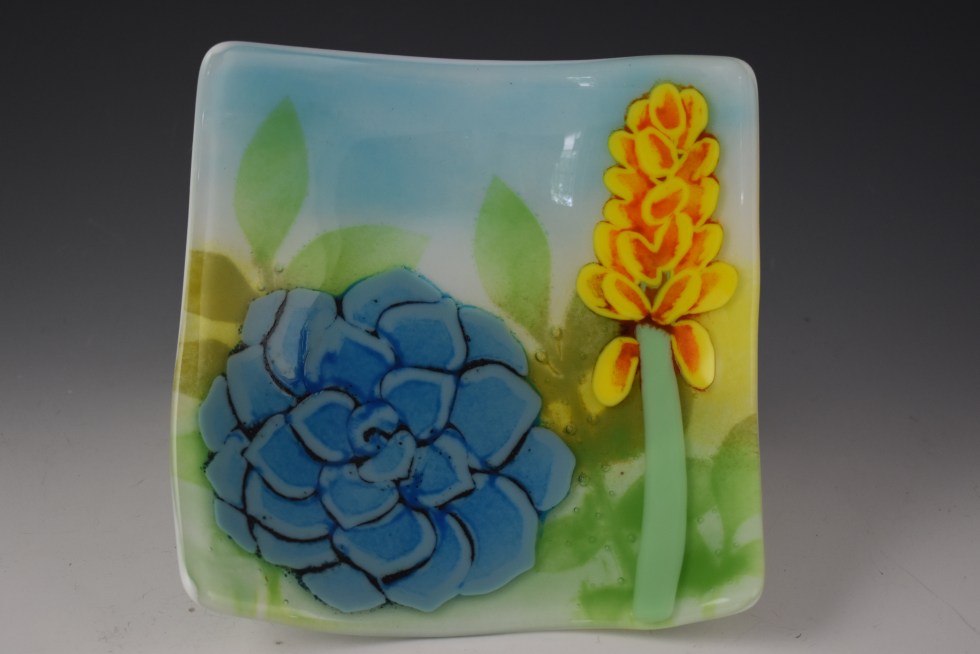
I cut a 6 inch by 6 inch square of white glass for the base of my project. Then I cut a 6 inch by 6 inch square of transparent color to stack on the white base. This simple combination was too plain for my artsy heart to handle. So, I used plastic stencils to give the plain glass a little pizazz. I quickly sifted green opal, powder frit over the stencil on the white base layer. I sifted yellow opal, powder frit over the stencil on the top color layer giving the project a subtle pattern. On the white base layer, I used a leaf pattern stencil. On the color layer, I used a flower pattern stencil to create delicate variations on the two layers. I intentionally applied in a higher concentration of frit on the left side of the base layer. On the color layer, I applied a higher concentration of frit on the right side. This way, you’d see each pattern independently and the two patterns overlapping in the middle of the square.
Loading your new kiln.
Place 3 or 4 short kiln posts on the floor of the kiln. Position the primed, or fiber paper lined, ceramic kiln shelf on the posts. Placing the ceramic shelf on posts makes it easier to load and unload the shelf. It also allows air to circulate around the shelf when the kiln is firing.
Important note about the position of your kiln shelf inside your kiln.
I use short posts on purpose to make sure the ceramic kiln shelf is positioned low inside the kiln. The posts are necessary for air flow around the ceramic shelf, so don’t skip them. But we also want to keep the glass project, assembled on the shelf as far away from the heating coils, in the lid as possible. You want a minimum of 5 to 6 inches between the glass project and the heating coils. If the glass is too close to the coils the glass can break due to thermal shock which is a result of heating too quickly.
The same applies for slumping molds.
It’s important to apply this same idea when placing a fused project on a slumping mold. In my smaller kilns, I remove the kiln shelf and place the slumping mold directly on the kiln floor to ensure that the glass is as far away from the heating coils as possible.
Be careful not to bump or bend the probe inside the kiln when loading the kiln shelf. The probe is a thermocouple that transmits the interior temperature of your kiln to the kiln’s controller.
Fiber board kiln shelves are different.
I place fiber board kiln shelves directly on the floor of my kilns without using any kiln posts. The fiber material is porous. Therefore, air circulates through the shelf ensuring even heating.
Glass fusing test fire.
I fired the assembled glass to a full fuse temperature on a primed ceramic kiln shelf. I used Auto Mode and the preset Full Fuse program in my Firebox 14 kiln controller. I was happy with the results.
Characteristics of a terrific full fuse firing.
The fused glass retained its square shape and original size of 6 inch by 6 inch. It also had uniform thickness, smooth surface, rounded edges and a clean back side. The frit design details melted into the top layer giving the project a shiny, smooth surface.
Characteristics of an under-fired full fuse firing.
An under-fired project will retain its square shape and its original size of 6 inch by 6 inch. The edges are hard, angular and sometimes sharp. Since the two layers are not completely fused together, a seam may appear on the edge showing how the layers were stacked. The back side of the project is clean and smooth. Design details, like frit may have texture and might not be fully melted into the top layer.
The solution to an under-fired project is to re-fire it a little hotter. To get more heat results, I usually add ten degrees to the target temperature. The target temperature is the temperature that gives you the desired results.
For full fuse results I fire the glass to 1465 degrees and hold it there for ten minutes. For tack fuse results I fire the glass to 1365 degrees and hold it there for 10 minutes. For slumping results, I fire the glass to 1265 degrees and hold it there for 10 minutes. (These temps are for COE 96 glass, but they will work equally as well in COE 90 glass.)
Characteristics of an over-fired full fuse firing.
An over-fired project will grow in size. The outside edges will round out. The glass will lose its square shape and be larger than the original 6 inch by 6 inch size. Kiln wash may stick to the backside and may be difficult to remove. The design details, like frit will be completely fired in giving the project a smooth shiny surface.
The solution for an over-fired project might be to grind the edges to regain the square shape. Or you can remake and re-fire the project at a lower temperature.
Glass slumping test fire.
To test how my new kiln slumped glass I placed a square ceramic mold in the kiln and positioned the fused glass on top. Using the controller and Auto Mode I set the kiln firing speed to fast and the process to slump. I was happy with the results.
Characteristics of a successful slump.
A successfully slumped glass project conforms to the shape of the mold. It also retains a clean shape and height of the sides of the project.
Characteristics of an under-slumped project.
An under-slumped project does not conform to the mold. The glass project doesn’t have enough drop and so the piece is shallow. The piece may also wobble on the table because it didn’t come in contact with the flat bottom of the mold like it should have.
The solution is to re-fire the glass in the mold and hold it at the target temperature a little longer than the first time. I usually add 10 minutes hold to the original program.
Characteristics of an over-slumped project.
An over-slumped project picks up a lot of texture from the mold. It also loses some of its shape because the sides slide down into the mold. The result is an uneven top edge or rim. The solution is to call it something new or remake the project.
Take notes.
I recommend taking notes on how you assemble your pieces and on your firing steps. This way you can easily reproduce your successes and learn from the pieces that didn’t come out as you expected.
Be brave. You can do it.
It takes a little time to become familiar with your new kiln. The good news is you’ll learn new and exciting things every step of the way. Don’t hesitate to jump in and start firing. No matter what your results are you’ll enjoy the creative process and making your own personalized pieces of art.
I believe in you!
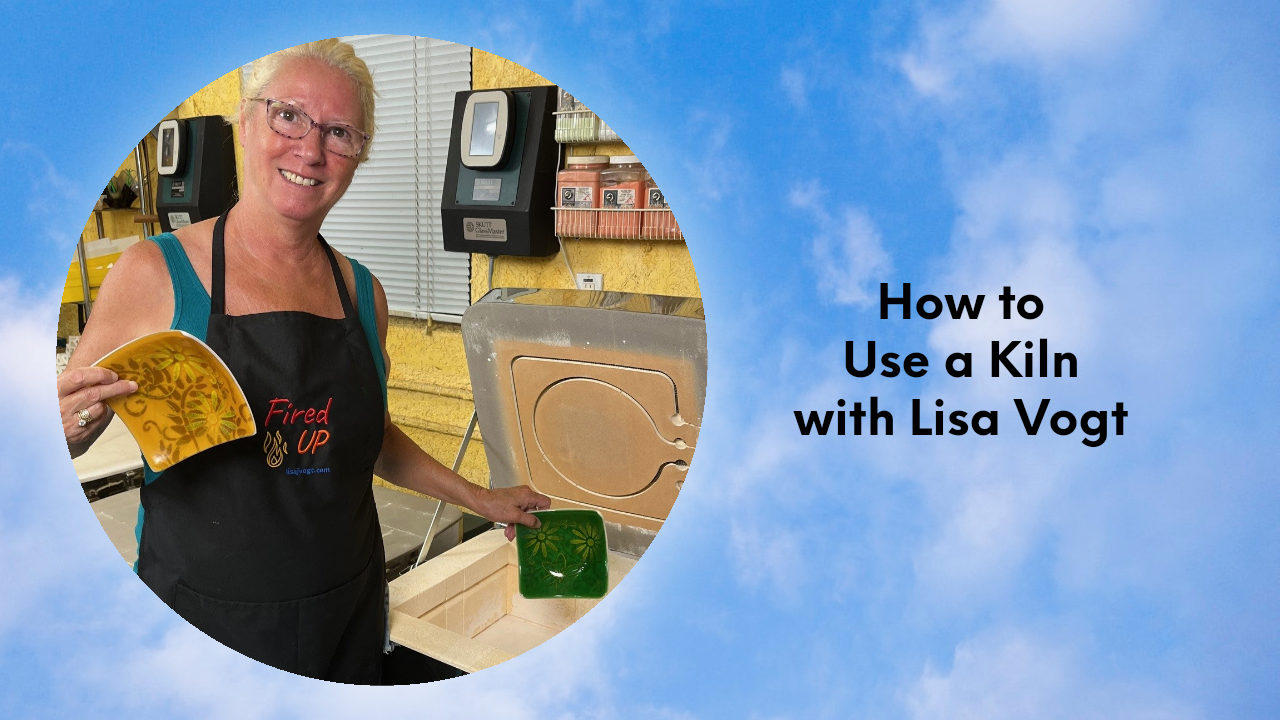
Check out my video to see how to use a kiln.
Follow my blog for weekly inspiration sent to your inbox!
Happy Fusing!
Lisa & Niki
Premium Video Courses by Lisa
Like this:
Like Loading...