

Cast glass is fascinating. It’s no wonder the sight of a meticulously executed piece sends your mind racing. You find yourself pulling up to admire and study it; to marvel at the bulky, sculptural character. You become captivated by the suspended design and colorful shards floating deep in space. You’re tempted to slide your finger tips lightly over the silky, smooth surface or to touch the magnified, grainy pattern embedded underneath. You guess how much it weighs; think about how it was made and calculate how long it took to fire.
Before long the complex technicalities sink in and become overwhelming, quickly building a road block that brings your run-away inspiration to a screeching halt. But the ride doesn’t have to stop there!

Amazing glass castings come in all sizes; by starting small you maximize your success rate. It enables you to work in multiples and test-drive several different types of techniques all at the same time. Plus the variety of projects will ramp up the production value and educational worth of the load making the commitment to a prolonged firing more agreeable and satisfying. Inevitably there will be surprises; some projects will come out far better than expected and others will lack luster. Good or bad though, there is something to be learned from every project whether the outcome is considered a success or not.
One of the things I like about making cast pieces is that the approach is different from straightforward glass fusing. The focus of basic fusing is the project and how efficiently it can be made. Casting is driven by process. It’s the sequence of multiple, singular steps carefully carried out over a period of time, seamlessly linked together that craft a engaging piece of art.

Casting begins with a mold; a form that can hold-up to the high heat inside the kiln while containing glass in a desired shape. For single use molds, to make one-of-a-kind pieces I recycle damaged ½ inch thick fiber board kiln shelf material. I determine how tall I want the fired piece to be. I add 25% to that measurement if I intend to use small material like course frit or mosaic sized glass shards to fill the mold or as much as 40% larger if I plan to use big chunks. The shapes needed are drawn out on an intact portion of the board with a pencil then cut using a straight edge and single edge razor blade.

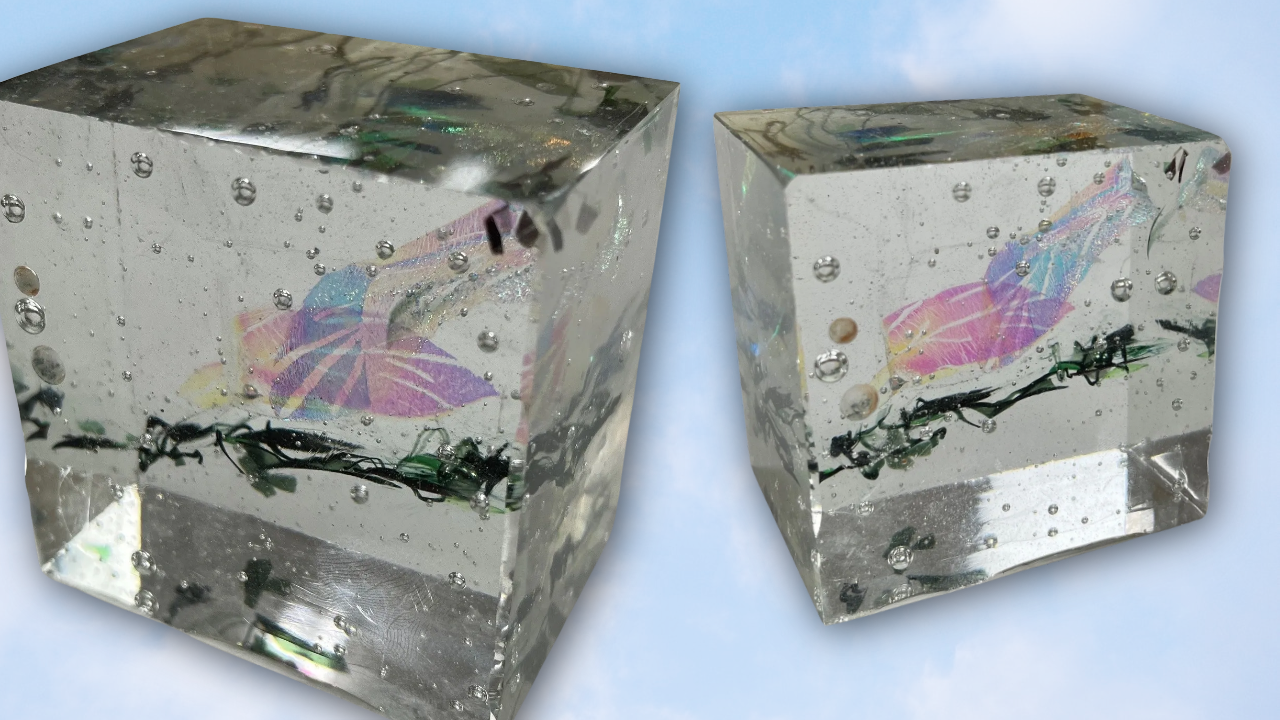
Drifting Leaf is an enchanting casting with a subtle suspended element floating inside. A dichroic, leaf shape, nestled in a web of delicately swaying green wisps seemingly hangs in space. This petite 3”x 3” x 2” size box is a terrific casting project to jump-start your creativity. It’s fast and easy to build, the floating element is fun to make, it uses a minimal amount of material and it can be fired in a smaller kiln. Most importantly, it’s good practice. The experience you gain will pave the way to bigger, more complex work.
Before filling the mold there are some things to consider. A mold filled with powder size clear frit will have a minimum amount of shrinkage. The finished piece will have tiny champagne like bubbles throughout, lack clarity and look milky. Fill the mold with fine clear frit and the number of bubbles will be reduced and the clarity somewhat improved. Load up the mold with medium or course clear frit and the bubbles will be fewer still, but larger and the clarity will be greatly improved. The shrinkage will be considerable. You can compensate for this by over filling the mold, mounding the glass higher than the side walls in the center. Casting rocks are another option. They are random sized chunks of practically bubble free glass formulated for casting. Using them can reduce the number of bubbles increasing optical clarity. It’s my common practice to mix mold fillers, catering the materials to the individual project and desired outcome.

The color used to fill the mold is yet another consideration. The beauty of cast glass is the transparency; the ability to see through the art. Medium colored shades of glass when piled up increase in density and result in unusually dark pieces. My advice would be to experiment with color and use it in moderation. Try a combination of applications like layering it with clear, choose pale shades over dark and use transparent glass as opposed to opal.

Cold working is the process of grinding and polishing glass to make the surfaces flat, smooth and shinny. Cast glass often needs some cold work touch up. If you are not familiar with the equipment a local hot shop will be able to do the polishing for a fee.
The trick to successfully firing cast glass is patience. It’s not a bad word! Here again I pay tribute to the benefit of nesting multiple, small pieces in a single firing. Greater value usually equals greater self control; usually.
Rev up your engine, give casting a try.

Follow my blog for weekly inspiration sent to your inbox!
If you enjoy reading my blog, I have a feature on my website you’ll like. From the home page click on any page. On the side bar you can read my Top 10 Blog Posts. The list updates every 48 hours so check back often.
Happy Fusing!
Lisa
Are you ready to take control of your artistic future?
Join me in October for my Advanced Glass Fusing workshop and put these career building concepts into immediate use. This is the turning point experience you’ve been waiting for.

JUST OPEN!
1 Seat is Available in my October 22-25, 2024 Advanced Glass Fusing Class.
Due to a change of events 1 seat is now available in my October 22-25, 2024 class. Deadline to register is September 17, 2024!
Upcoming Class!
Advanced Glass Fusing Class
4-Day, Hands-on Class, Wesley Chapel, FL
ONLY 2 SEATS LEFT!
February 4-7, 2025

YOU can make gallery quality fused glass art! You’ll love the personalized instruction in this exciting advanced technique, artistic awakening and skill building workshop. This is the turning point experience you’ve been waiting for.
Someday is here! What are you waiting for? You’re in your prime. You’re at the peak of your interest in glass fusing. Take the next step and raise your artwork to an exciting new level of sophistication.
Join me for this intense workshop held in my private studio.
Wesley Chapel, Florida, 4-Day, Hands-on, Class size is limited.
In this class, you will push the boundaries art glass imposes. Students will explore innovative approaches to design and combine multiple advanced techniques to construct original art that reflects their own personal style. You’ll enjoy: the one-on-one instruction, making multifaceted projects, the well-equipped classroom, and the intimate class size.
You’ll love the concentrated, in-depth study and creative momentum you’ll gain while actively producing, nonstop for four consecutive days. You’ll leave class with a working knowledge of kiln operation, custom project specific firing guides, and the inspiration you’ve been craving to go bigger and do more elaborate works of fused glass art!
Join me and take your glass fusing to the next level!
Premium Video Courses by Lisa